
A treasure trove of ideas in psychoanalysis. History, theory, and psychoanalytic perspectives on a diverse range of topics. www.freud.org.uk
Episodes
Jun 10, 2020
Jun 10, 2020
44 min
Lisa Appignanesi discusses her new book, Everyday Madness: on Grief, Anger, Loss and Love (September 2018) with Adam Phillips.
‘The small translucent bottle of shampoo outlived him. It was the kind you take home from hotels in distant places. For over a year it had sat on the shower shelf where he had left it. I looked at it every day.”
After the death of her partner of thirty-two years, Lisa Appignanesi was thrust into a state striated by rage and superstition in which sanity felt elusive. The dead of prior generations loomed large and haunting. Then, too, the cultural and political moment seemed to collude with her condition: everywhere people were dislocated and angry.
In this electrifying and brave examination of an ordinary enough death and its aftermath, Appignanesi uses all her evocative and analytic powers to scrutinize her own and our society’s experience of grieving, the effects of loss and the potent, mythical space it occupies in our lives.
With searing honesty, lashed by humour, she navigates us onto the terrain of childhood, the way it forms our feelings of love and hate, and steers us towards a less tumultuous version of the everyday.
This book may be short, but life, death, madness, love, and grandchildren, are all there seen through the eyes of a writer who is ever aware of the historical and current vagaries of woman’s condition.
Everyday Madness: on Grief, Anger, Loss and Love is available
from the Freud Museum Shop.
‘Appignanesi luminously conveys the wayward emotions that make bereavement a language that is hard to understand, yet speaks to us every day when we experience a great loss. You will find all of life in this rewarding, scholarly and entertaining conversation about freedom, Freud, fury, enduring love, and how mythic and modern families haunt each other’
Deborah Levy‘Wonderful, moving, extraordinary. It is sui generis. I feel enormously privileged to have read it – twice. Its structure is remarkable – an enacting of the last two years. Bravo bravo’
Edmund de Waal
Lisa Appignanesi has been a university lecturer in European Studies and was Chair of the Freud Museum London. Her works of non-fiction include ‘Freud’s Women’ (with John Forrester), a biographical portrait of Simone de Beauvoir, and a history of cabaret. She has edited ‘The Rushdie File’ and a number of books on contemporary culture, as well as producing various films for television. Lisa Appignanesi lives in London with her two children.
Adam Phillips is a practising psychoanalyst and a visiting professor in the English department at the University of York. He writes regularly for the London Review of Books, the Observer and the New York Times, and he is General Editor of the Penguin Modern Classics Freud translations. His most recent book is In Writing and he recently curated an exhibition, The Vulgar: Fashion Redefined, at the Barbican, London.
Jun 5, 2020
Jun 5, 2020
1 hr 26 min
Joanna Ryan in discussion with Barry Watt

What does psychoanalysis have to say about the emotional landscapes of class, the hidden injuries and disavowed privileges? How does class figure in clinical work and what part does it play in psychotherapeutic trainings?
In these times of increasing inequality, Joanna Ryan will discuss aspects of her timely new book Class and Psychoanalysis: Landscapes of Inequality, exploring what can be learned about the psychic formations of class, and the class formations of psychoanalysis. Addressing some of the many challenges facing a psychoanalysis that aims to include class in its remit, she holds the tension between the radical and progressive potential of psychoanalysis, in its unique understandings of the unconscious, with its status as a mainly expensive and exclusive practice.
The aim of this evening’s discussion, part of the 20th anniversary celebrations of the Site for Contemporary Psychoanalysis, is to open up debate about this important but neglected subject.
“Class and Psychoanalysis is a text of great importance. Joanna Ryan writes in a clear and objective way about the neglect of social class in psychoanalysis, yet behind this objectivity is a passionate involvement that will strike a chord with all concerned psychoanalysts and psychotherapists. The book presents the best available overview of the history, theory and practice of psychoanalysis in relation to social class, combining this with interview material from the author’s own studies of psychotherapists to give a detailed and compelling picture of how class enters the consulting room. Engaging with this profound yet accessible book is essential for all who care about class injuries and how we might find ways to respond to them.” - Stephen Frosh, Professor of Psychosocial Studies, Birkbeck, University of London
Joanna Ryan, Ph.D., is a psychoanalytic psychotherapist; she has worked widely in clinical practice, teaching and supervision; in academic research; and in the politics of psychotherapy. She is co-author (with N. O'Connor) of Wild Desires and Mistaken Identities: Lesbianism and Psychoanalysis; co-editor (with S. Cartledge) of Sex and Love: New Thoughts on Old Contradictions; author of The Politics of Mental Handicap and many other publications.
Barry Watt is a psychoanalytic psychotherapist, a senior psychotherapist at the Psychosis Therapy Project, a member of The Site for Contemporary Psychoanalysis and a social housing activist and campaigner.
May 30, 2020
May 30, 2020
1 hr 41 min
In The Not-Two, Lorenzo Chiesa examines the treatment of logic and God in Lacan’s later work.
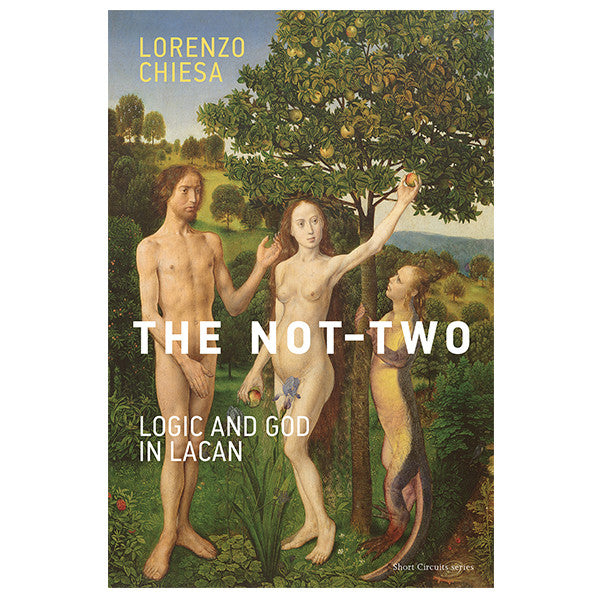
Chiesa draws for the most part from Lacan’s Seminars of the early 1970s, as they revolve around the axiom "There is no sexual relationship." Chiesa provides both a close reading of Lacan’s effort to formalize sexual difference as incompleteness and an assessment of its broader implications for philosophical realism and materialism.
Chiesa argues that "There is no sexual relationship" is for Lacan empirically and historically circumscribed by psychoanalysis, yet self-evident in our everyday lives. Lacan believed that we have sex because we love, and that love is a desire to be One in face of the absence of the sexual relationship. Love presupposes a real "not-two." The not-two condenses the idea that our love and sex lives are dictated by the impossibility of fusing man’s contradictory being with the heteros of woman as a fundamentally uncountable Other. Sexual liaisons are sustained by a transcendental logic, the so-called phallic function that attempts to overcome this impossibility.
Chiesa also focuses on Lacan’s critical dialogue with modern science and formal logic, as well as his dismantling of sexuality as considered by mainstream biological discourse. Developing a new logic of sexuation based on incompleteness requires the relinquishing of any alleged logos of life and any teleological evolution.
For Lacan, the truth of incompleteness as approached psychoanalytically through sexuality would allow us to go further in debunking traditional onto-theology and replace it with a “para-ontology” yet to be developed. Given the truth of incompleteness, Chiesa asks, can we think such a truth in itself without turning incompleteness into another truth about truth, that is, into yet another figure of God as absolute being?
Lorenzo Chiesa is a philosopher who has published extensively on psychoanalysis. His works in this field include Subjectivity and Otherness: A Philosophical Reading of Lacan (MIT Press, 2007); Lacan and Philosophy: The New Generation (Re.press, 2014); The Not-Two: Logic and God in Lacan (MIT Press, 2016); and The Virtual Point of Freedom (Northwestern University Press, 2016). Since 2014, he has been Visiting Professor at the European University at Saint Petersburg and at the Freud’s Dream Museum of the same city. Previously, he was Professor of Modern European Thought at the University of Kent, where he founded and directed the Centre for Critical Thought.
May 25, 2020
May 25, 2020
1 hr 20 min
In his latest publication In Writing acclaimed psychoanalyst and writer, Adam Phillips celebrates the art of close reading and asks what it is to defend literature in a world that is increasingly devaluing language in this enjoyable collection of essays on literature.

Through an exhilarating series of encounters with – and vivid readings of – writers he has loved, from Byron and Barthes to Shakespeare and Sebald, Phillips infuses the love of writing with deep insights drawn from his work as a practicing psychoanalyst to demonstrate, in his own unique style, how literature and psychoanalysis can speak to and of each other.
For Adam Phillips - as for Freud and many of his followers - poetry and poets have always held an essential place, as both precursors and unofficial collaborators in the psychoanalytic project. But the same has never held true in reverse. What, Phillips wonders, at the start of this deeply engaging book, has psychoanalysis meant for writers? And what can writing do for psychoanalysis?
He discusses how literature and psychoanalysis can speak to and of each other with psychoanalyst and writer, Josh Cohen.
'Reading Phillips, you may be amused, vexed, dazzled. But the one thing you will never be is bored.'
Observer
'It is a pleasure simply to hear him think.'
Sunday Telegraph
Adam Phillips is a practising psychoanalyst and a visiting professor in the English department at the University of York. He writes regularly for the London Review of Books, the Observer and the New York Times, and he is General Editor of the Penguin Modern Classics Freud translations. His most recent book is In Writing and he recently curated an exhibition, The Vulgar: Fashion Redefined, at the Barbican, London.
Josh Cohen is a psychoanalyst in private practice and Professor of Literary Theory at Goldsmiths University of London. He is the author of four books and numerous articles on psychoanalysis, modern literature and cultural theory, including How to Read Freud and, most recently, The Private Life: Why We Remain in the Dark. He is currently completing a book on inertia on psychic and cultural life, provisionally titled Not Working.
May 20, 2020
May 20, 2020
1 hr 12 min
Re-reading Freud's 1905 edition of Three Essays on the Theory of Sexuality
This book presentation is devoted to the newly translated and annotated English edition of Freud’s 1905 Three Essays on the Theory of Sexuality (Verso, 2016).
Freud’s publication is one of the grounding texts of 20th-century European thinking. In it Freud develops a highly innovative theory of sexuality for which pathology serves as a model to understand human existence. Freud published this text five times during his lifetime. In the book presentation, the editors will highlight the potential of the text in its relevance for contemporary psychoanalytic theory. This potential concerns three main issues. First, the text is important as regards its theory of sexuality: infantile sexuality is seen as strictly autoerotic and without an object, and hence, cannot be described in oedipal terms – Freud’s first theory of sexuality is a non-oedipal theory. Second, Freud opts for a very interesting, "pathoanalytic“ perspective on sexuality, when using the psychoneuroses (especially hysteria) as the model to understand the general human sexual constitution. Third, Freud offers a profound critique of heteronormative and functional theories of sexuality and the perversions in his contemporary psychiatric and sexological literature. Re-reading the Three Essays shows that we have to reconsider the genesis of Freudian thinking, and psychoanalysis’ potential in contemporary debates on sexuality, gender and normativity.
Biographies:
Philippe Van Haute is Professor at the Center for Contemporary European Philosophy, Radboud University Nijmegen, the Netherlands, and Extraordinary Professor of philosophy at the University of Pretoria, South Africa. He is a psychoanalyst of the Belgian School for Psychoanalysis and a founding member of the Société internationale de psychanalyse et de philosophie/ International Society for Psychoanalysis and Philosophy. He has published numerous books, among them Against Adaptation (2002), Confusion of Tongues (with Tomas Geyskens, 2004), From Death Drive to Attachment Theory (with Tomas Geyskens, 2007), and A Non-oedipal Psychoanalysis? (with Tomas Geyskens, 2012). He is the coeditor of the book series Figures of the Unconscious (Louvain University Press).
Herman Westerink is Lecturer at the Center for Contemporary European Philosophy, Radboud University Nijmegen, the Netherlands, and Extraordinary Professor at the University of Leuven, Belgium. He is a member of the Société internationale de psychanalyse et de philosophie/International Society for Psychoanalysis and Philosophy. He has published numerous books and articles on psychoanalysis, including A Dark Trace: Sigmund Freud on the Sense of Guilt (2009) and The Heart of Man’s Destiny (2012). He is Editor of the book series Sigmund Freud's Werke: Wiener Interdisziplinäre Kommentare.
May 15, 2020
May 15, 2020
50 min
Lacanian psychoanalyst Bruce Fink discusses his latest work, Lacan on Love.
Quintessentially fascinating, love intrigues and perplexes us, and drives much of what we do in life. As wary as we may be of its illusions and disappointments, many of us fall blindly into its traps and become ensnared time and again. Deliriously mad excitement turns to disenchantment, if not deadening repetition, and we wonder how we shall ever break out of this vicious cycle.
Can psychoanalysis – with ample assistance from philosophers, poets, novelists, and songwriters – give us a new perspective on the wellsprings and course of love? Can it help us fathom how and why we are often looking for love in all the wrong places, and are fundamentally confused about “what love really is”?
In this lively and wide-ranging exploration of love throughout the ages, Fink argues that it can. Taking within his compass a vast array of traditions – from Antiquity to the courtly love poets, Christian love, and Romanticism – and providing an in-depth examination of Freud and Lacan on love and libido, Fink unpacks Lacan’s paradoxical claim that “love is giving what you don’t have.” He shows how the emptiness or lack we feel within ourselves gets covered over or entwined in love, and how it is possible and indeed vital to give something to another that we feel we ourselves don’t have.
This first-ever commentary on Lacan’s Seminar VIII, Transference, provides readers with a clear and systematic introduction to Lacan’s views on love. It will be of great value to students and scholars of psychology and of the humanities generally, and to analysts of all persuasions.
Lacan on Love: An Exploration of Lacan's Seminar VIII, Transference is published by Polity. Available from the Freud Museum Shop.
May 10, 2020
May 10, 2020
33 min
Starting from the hypothesis that psychosis makes up a structure, with a precise status for the unconscious, Stijn Vanheule explores how, from a Lacanian point of view, the treatment of psychosis is organized. Special attention is paid to the specificity of the psychotic symptom, or elementary phenomenon, and to the way transference characteristically takes shape. Crucial to this approach of treatment is that the psychoanalyst aims at restoring a place for the subject in relation to the Other, which is threatened in episodes of acute psychosis.
Stijn Vanheule is professor of psychoanalysis and chair of the Department of Psychoanalysis and Clinical Consulting at Ghent University (Belgium), and a psychoanalyst in private practice (member of the New Lacanian School for Psychoanalysis and World Association of Psychoanalyse). He is the author of The Subject of Psychosis – A Lacanian Perspective(Palgrave Macmillan, 2011) and Diagnosis and the DSM – A Critical Review (Palgrave Macmillan, 2014), and of multiple papers on Lacanian and Freudian psychoanalysis, psychoanalytic research into psychopathology, and clinical psychodiagnostics.
From the 'Psychosis and Psychoanalysis', a conference organised in collaboration with the Psychosis Therapy Project, a therapy service for people experiencing psychosis.
May 5, 2020
May 5, 2020
1 hr 31 min
- What actually happens in psychotherapy?
- How long might therapy last?
- Does therapy blame everything on one’s parents?
- Will I be cured or will I be brain-washed?
- How do I find an experienced and trustworthy psychotherapist?
- How much will psychotherapy cost?
- Will I still recognise myself at the end of the process?
- Might there be any risks associated with undergoing therapy?
Apr 30, 2020
Apr 30, 2020
19 min
Discussion Only.
Nominated for the Turner Prize in 1997, Cornelia Parker became well known for her installations and interventions, including Cold Dark Matter: An Exploded View 1991 (Tate Modern) where she suspended the fragments of a garden shed, blown up for her by the British Army, and The Maybe, a collaboration with actress Tilda Swinton, at the Serpentine Gallery in 1995. She is currently working on the annual roof commission for the Metropolitan Museum, New York.
She has works in the Tate Collection, MoMA and Met Museum NY and in numerous public and private collections in Europe and the USA. She was elected to the Royal Academy in 2009 and awarded an OBE 2010. She is represented by Frith Street Gallery, London.
Darian Leader is a writer, psychoanalyst, trustee of the Freud Museum and founding member of the Centre for Freudian Analysis and Research. He has written numerous books, including Strictly Bipolar (2013), What is Madness? (2011), The New Black (2008) and Freud's Footnotes (2000).
Apr 25, 2020
Apr 25, 2020
1 hr 14 min
Apr 20, 2020
Apr 20, 2020
1 hr 53 min
Understanding the Socio-psychological Roots of Contemporary Right-wing Populism
Apr 15, 2020
Apr 15, 2020
1 hr 15 min
Panel discussion - Jane Haberlin, Jeanette Winterson and Eleanor Longden
Apr 10, 2020
Apr 10, 2020
51 min
Adam Phillips in conversation with Deborah Levy
Adam Phillips takes Oscar Wilde as a springboard for a deep dive into the meanings and importance of the Unforbidden, from the fall of our 'first parents' Adam and Eve to the work of the great twentieth-century psychoanalytic thinkers.
Unforbidden pleasures, he argues, are always the ones we tend not to think about, yet when you look into it, it is probable that we get as much pleasure, if not more, from them. And we may have underestimated just how restricted our restrictiveness, in thrall to the forbidden and its rules, may make us.
Adam Phillips is a psychoanalyst and the author of several previous books, all widely acclaimed, including On Kissing, Tickling and Being Bored, Going Sane and Side Effects. His most recent books are On Kindness, co-written with the historian Barbara Taylor, Missing Out: In Praise of the Unlived Life, On Balance and One Way and Another.
‘Every mind-blowing book from Adam Phillips suspends all the certainties we are most attached to and somehow makes this feel exhilarating’ - Deborah Levy
‘Phillips radiates infectious charm. The brew of gaiety, compassion, exuberance and idealism is heady and disarming’ - Sunday Times
‘Phillips is one of the finest prose stylists at work in the language, an Emerson for our time’ - John Banville
Unforbidden Pleasures is published by Hamish Hamilton (5 November 2015)
Deborah Levy writes fiction, plays, and poetry. Her work has been staged by the Royal Shakespeare Company, and she is the author of highly praised books including The Unloved, Swallowing Geography, and Beautiful Mutants. Her novel Swimming Home was shortlisted for the Man Booker Prize. In 2012 Levy adapted two of Freud's case histories, Dora and The Wolfman for BBC Radio 4. Things I Don’t Want to Know is the title of Levy’s sparkling response to George Orwell’s essay ‘Why I Write’, an autobiographical essay on writing, gender politics and philosophy. Her new novel, Hot Milk, will be published in 2016 by Hamish Hamilton.
Apr 5, 2020
Apr 5, 2020
1 hr 31 min
Session 4: The Unconscious and the Body
Apr 5, 2020
Apr 5, 2020
1 hr 20 min
Session 3: The Freudian Unconscious Revisited
Apr 5, 2020
Apr 5, 2020
1 hr 10 min
Apr 5, 2020
Apr 5, 2020
1 hr 35 min
Session 1: The Unconscious and the Brain
Mark will present neuroscientific evidence to support his argument that the mental functions Freud called ‘id’ are not unconscious! He will discuss some implications of this argument for what psychoanalysts and psychotherapists do clinically.
Mark Solms is a psychoanalyst and neuropsychologist, widely reported to have first coined the term Neuro-Psychoanalysis, a rapidly developing field of interdisciplinary scholarship and research aiming to provide bridges between the neurosciences and psychoanalytic theory. He is Professor in Neuropsychology at the University of Cape Town (South Africa), Honorary Lecturer in Neurosurgery at St Bartholomew’s and Royal London School of Medicine, Director of the Arnold Pfeffer Center for Neuropsychoanalysis at the New York Psychoanalytic Society and Institute, and Chair of the Research Committee of the International Psychoanalytical Association. He is President of the South African Psychoanalytical Association, Associate Member of the British Psychoanalytical Society, Honorary Member of the New York Psychoanalytic Society, and Member of the South African Clinical Neuropsychology Association and of the British Neuropsychological Society. He is a Member of the Academy of Science of South Africa, and Honorary Fellow of the American College of Psychoanalysts and of the American College of Psychiatrists. He has won many prestigious awards, including the Sigourney Award, and has authored a multitude of chapters, articles and books including A moment of Transition: Two Neuroscientific Articles by Sigmund Freud (1990), The Neuropsychology of Dreams: A Clinico-Anatomical Study (1997), Clinical Studies in Neuro-Psychoanalysis (with K Kaplan-Solms, 2000) and, with Oliver Turnball, The Brain and the Inner World: An Introduction to the Neuroscience of Subjective Experience (2002). He was founding editor of the journal Neuropsychoanalysis.
Mar 30, 2020
Mar 30, 2020
59 min
Lecture and performance:
How do ideas pop into your head? You can think about the answer to this question at a lecture and performance about the art of Freestyle Rap by Hip-Hop artist and spoken word poet, Reveal. Using recent studies in neurology and psychology, theories of memory schemata and ideas about unconscious communication, Reveal will explore the basis of his craft within the resonant environment of the Freud Museum, and in a practical demonstration will improvise a rap to words and questions called out by members of the audience.
Reveal is a London based Iranian Hip-Hop artist, ethnomusicologist and writer. He was born in Tehran, Iran in 1983 and moved to London aged 2 with his parents, mainly to escape the Iran-Iraq war. He was raised in inner city London but continued to travel back to Tehran regularly. Having links to such contrasting urban environments has provided him with a sense of dual identity for most of his life. At a young age Reveal began performing Hip-Hop music and releasing songs under the Artist name "Reveal Poison", and at aged 16 he won the 2000 UK Freestyle Knock-out Battle Rap Championships. He went on to form the group “Poisonous Poets” who were one of the first ever UK Hip-Hop acts to be signed to a major record label, penning a deal with BMG/Arista in 2001. It was around this period that he first became aware of the emerging Persian Hip-Hop scene in Iran and he travelled back to Tehran to begin a series of collaborations with the city's artists. Reveal is currently enrolled on a Mmus Ethnomusicology programme at SOAS where he is studying part-time alongside doing youth work, touring and releasing music.
Mar 25, 2020
Mar 25, 2020
1 hr 8 min
While the contents of the unconscious might be obscure and perplexing, when Freud spoke about 'the unconscious' he meant something very precise. This talk will look at Freud's 'discovery' of the unconscious, and at his conceptualisation of it. It will also deal with the peculiar logic of symptom formation. From there, it will go on to look at Lacan's notion of the language-like unconscious, showing how this was developed in accordance with Freud's ideas.
Anouchka Grose is a psychoanalyst and writer practising in London. She is a member of the Centre for Freudian Analysis and Research, where she regularly lectures. She is the author of No More Silly Love Songs: a realist’s guide to romance (Portobello, 2010) and Are you Considering Therapy (Karnac, 2011), and is the editor of 'Hysteria Today', a collection of essays to be published by Karnac later this year. She also writes for The Guardian and teaches at Camberwell School of Art.
Part of an exciting season of talks, events and conferences accompanying the exhibition ‘Festival of the Unconscious’, 24 June- 4 October 2015.
Mar 20, 2020
Mar 20, 2020
4 hr 6 min
Civilization and its Discontents: A Marathon Reading
The Centre for Creative and Critical Thought at the University of Sussex together with the Freud Museum London are pleased to announce a marathon reading of Sigmund Freud’s classic text, Civilization and its Discontents, at the Freud Museum on Sunday 14 June.
Civilization and Its Discontents, written in 1929, remains the definitive text on human destructiveness. As news of wars around the globe, appalling brutality, religious conflict and sexual violence continue unabated, the relevance of this work is undeniable. ‘Men are not gentle creatures’ Freud wrote, ‘but ...creatures whose instinct [is] aggressiveness.’
The event is free with an admission ticket to the Freud Museum. There are no tickets and audience members can come and go as they please. This is a staged reading and interactive performance.
The reading will last in all approximately four and a half hours. At the end, after the Museum closes, audience members are invited to stay for discussion and light refreshments.
This staged reading revisits a classic text in a modern context, a face-to-face encounter for those hungry to engage with serious and pertinent ideas. A successful similar event took place in New York in January, and this is the first European marathon reading. Readers will include well known psychoanalysts, academics, writers, artists and performers. A list of confirmed names will be added shortly.
“To read Civilization and its Discontents in 2015 is to bear witness to the deadly violence whose daily presence is all-too-familiar to us and imagine the conditions that might provide a loving counterweight to that violence.”
Simon Critchley, Philosopher.
Readers include:
Sara Jane Bailes, University of Sussex
Caroline Bainbridge, Roehampton University
Julia Borossa, Middlesex University
Peter Boxall, University of Sussex
Josh Cohen, Goldsmiths, University of London, psychoanalyst
Gerald Davidson, actor, researcher
Simon Glendinning, LSE, Philosopher
Anouchka Grose, psychoanalyst and author
Rachel Holmes, historian and author
Deborah Levy, novelist
Michael Molnar, researcher and former Director, Freud Museum London
David Morgan, consultant psychotherapist, psychoanalyst Bpas Bpa
Ankhi Mukherjee, University of Oxford
Cathy Naden, performer/writer
Dany Nobus, Brunel University London
Ruth Padel, poet
Jocelyn Pook, composer and musician
Eric Prenowitz, University of Leeds
Alan Read, King's College London
Caroline Rooney, University of Kent
Nicholas Royle, University of Sussex
Kalu Singh, author
Marquard Smith, Kingston University
David Williams, RHUL, writer, dramaturg
Timberlake Wertenbaker, playwright
Sarah Wood, University of Kent
Mar 10, 2020
Mar 10, 2020
1 hr 20 min
Session 4: USERS' AND EDUCATORS' PERSPECTIVES
Mar 10, 2020
Mar 10, 2020
1 hr 16 min
Session 3: EXTERNAL CRITIQUES
Mar 10, 2020
Mar 10, 2020
1 hr 24 min
Mar 10, 2020
Mar 10, 2020
1 hr 19 min
Mar 5, 2020
Mar 5, 2020
1 hr 24 min
Feb 29, 2020
Feb 29, 2020
1 hr 23 min
Colette Soler, joined by Darian Leader
Lacan’s work is often caricatured as arcane, convoluted, ‘theoretical’ and, above all, difficult. But Lacan himself engaged continually with the ideas of his contemporaries and grounded his work in analytic practice. If you have been put off reading Lacan in the past, here is a chance to see what the fuss is about, in a way that relates directly to clinical work and wider issues of the world we live in.
Colette Soler - Psychoanalyst, Founder Member of the Ecole de Psychanalyse des Forums du Champ Lacanien. Her books include What Lacan said about Women (Other Press, 2006) and Lacanian Affects (Routledge, 2014).
Darian Leader - British psychoanalyst and author. He is a founding member of the Centre for Freudian Analysis and Research (CFAR), President of the College of Psychoanalysts, a Trustee of the Freud Museum, and Honorary Visiting Professor in Psychoanalysis at Roehampton University.
This recording may not be further used or cited without the express permission of the speakers.
Feb 25, 2020
Feb 25, 2020
1 hr 7 min
Feb 20, 2020
Feb 20, 2020
1 hr 12 min
Feb 15, 2020
Feb 15, 2020
1 hr 10 min
Feb 10, 2020
Feb 10, 2020
55 min
Paul Coldwell (University of the Arts London) discusses his work exploring the relations between art, the archive, the uncanny and the museum. With Carol Seigel, Director of the Freud Museum.
Feb 5, 2020
Feb 5, 2020
1 hr 22 min
Jan 31, 2020
Jan 31, 2020
1 hr 32 min
Jan 25, 2020
Jan 25, 2020
1 hr 3 min

Jan 21, 2020
Jan 21, 2020
1 hr 17 min
Lynne Segal and Susie Orbach in conversation
Feminist writer and activist, Lynne Segal, discusses her recently published Out of Time: The Pleasures and Perils of Ageing with psychotherapist, psychoanalyst, social critic and writer Susie Orbach - author of many celebrated books, amongst them Bodies and On Eating, and recently co-edited Fifty Shades of Feminism, with Lisa Appignanesi and Rachel Holmes.
In her autobiography Making Trouble (2007), Segal described herself as ‘a reluctantly ageing woman’, and mused about the need for ‘a feminist sexual politics of ageing’. Out of Time is her answer to these issues.
Fears of ageing, Segal argues, are fed to us from childhood in stories and fairy tales full of monstrous, quintessentially female, figures. She confronts the simplistic attributions of generational blame frequently named as causes of the economic crisis, the growing erotic invisibility for ageing women as well as the expectations of gender and ageing that inevitably constrain ambition and political engagement.
Out of Time also examines the representation of ageing in the work of other writers (many of them feminists) including Simone de Beauvoir, Alice Walker, Adrienne Rich, Philip Roth, Diane Athill, Joyce Carol Oates, John Berger, Grace Paley, Jo Brand, Jacques Derrida and John Updike.
Out of Time: The Pleasures and Perils of Ageing (Novemeber 2013) Verso
Jan 17, 2020
Jan 17, 2020
1 hr 22 min
Jacqueline Rose and Sally Alexander in conversation
Jan 13, 2020
Jan 13, 2020
1 hr 7 min
Jan 9, 2020
Jan 9, 2020
1 hr 3 min
Giles Fraser in conversation with Adam Phillips
Jan 8, 2020
Jan 8, 2020
1 hr 24 min
Aaron Balick in conversation with Susie Orbach
A collaboration between The Relational School and The Freud Museum London, exploring the impact that social networking has had on our society and how it is profoundly influencing our lives.
Over the past decade the very nature of the way we relate to each other has been utterly transformed by online social networking and the mobile technologies that enable unfettered access to it. Our very selves have been extended into the digital world in ways previously unimagined, offering us instantaneous relating to others over a variety of platforms like Facebook and Twitter. In ‘The Psychodynamics of Social Networking’, Aaron Balick draws on his experience as a psychotherapist and cultural theorist to interrogate the unconscious motivations behind our online social networking use: powerfully arguing that social media is not just a technology, but is essentially human and deeply meaningful.
'The Psychodynamics of Social Networking' is the first book to be published in the new series "Psychoanalysis and Popular Culture" produced by the Media and the Inner World research network [MiW] and Karnac Books.
Dr Aaron Balick is a UKCP registered psychotherapist, supervisor and a media and social networking consultant working in London. Aaron is also an honorary lecturer at the Centre for Psychoanalytic Studies at the University of Essex where he participates in the post-graduate MA and PhD programmes in psychoanalytic studies. He writes for both academic and lay audiences having published several academic articles and book chapters while at the same time contributing a psychological angle on national press and radio. Aaron is a media spokesperson for the UKCP and a regular contributor as the "resident psychotherapist" on BBC Radio One's phone-in show, The Surgery with Aled and Dr. Radha.
Susie Orbach is a psychoanalyst, writer and social critic. She co-founded The Women's Therapy Centre in 1976, has consulted to NHS, The World Bank and other organisations. She is convenor of www.endangeredbodies.org. She is Chair of the Relational School and the author of eleven books. She was Visiting Professor at LSE and a Guardian columnist for ten years. She is a member of the Government's expert panel on body image.
The Relational School is dedicated to understanding the therapeutic relationship and the uses of the inter-subjective space that is co-created within the therapeutic dyad. Our activities aim to create forums for further conversations around relationality coming from a variety of therapeutic disciplines as well as a formal association to disseminate the work.
Jan 4, 2020
Jan 4, 2020
1 hr 30 min
Author's Talk - Gohar Homayounpour introduced by M Fakhry Davids Is psychoanalysis possible in the Islamic Republic of Iran? This is the question that Gohar Homayounpour poses to herself, and to us, at the beginning of this memoir of displacement, nostalgia, love, and pain. Twenty years after leaving her country, Homayounpour, an Iranian, Western-trained psychoanalyst, returns to Tehran to establish a psychoanalytic practice. When an American colleague exclaims, "I do not think that Iranians can free-associate!" Homayounpour responds that in her opinion Iranians do nothing but. Iranian culture, she says, revolves around stories. Why wouldn't Freud's methods work, given Iranians' need to talk? Thus begins a fascinating narrative of interlocking stories that resembles--more than a little--a psychoanalytic session. Homayounpour recounts the pleasure and pain of returning to her motherland, her passion for the work of Milan Kundera, her complex relationship with Kundera's Iranian translator (her father), and her own and other Iranians' anxieties of influence and disobedience. Woven throughout the narrative are glimpses of her sometimes frustrating, always candid, sessions with patients. Ms. N, a famous artist, dreams of abandonment and sits in the analyst's chair rather than on the analysand's couch; a young chador-clad woman expresses shame because she has lost her virginity; an eloquently suicidal young man cannot kill himself. As a psychoanalyst, Homayounpour knows that behind every story told is another story that remains untold. 'Doing Psychoanalysis in Tehran' connects the stories, spoken and unspoken, that ordinary Iranians tell about their lives before their hour is up. The foreword was written by Abbas Kiorastami who is an internationally acclaimed Iranian filmmaker. His most recent film is 'Certified Copy', starring Juliette Binoche, and 'Like Someone In Love'. Gohar Homayounpour is a practicing psychoanalyst in Tehran. She trains and supervises the psychoanalysts of the Freudian Group of Tehran and is Professor of Psychology at Shahid Besheti University Tehran. M Fakhry Davids MSc (Clin Psych) F Inst Psychoanal, is a psychoanalyst and adult psychotherapist in full-time clinical practice in London. He is a Fellow of the British Psychoanalytic Society, a Member of the Tavistock Society of Psychotherapists, and a founding Board Member of PCCA (Partners in Confronting Collective Atrocities). He has held academic and clinical positions in South Africa and the UK, and is a Visiting Lecturer at the Tavistock Clinic. He has written on a number of psychoanalytic topics, and has a long-standing interest in whether psychoanalysis is able to journey beyond its Western bourgeois birthplace across boundaries of race, class and culture. His book, Internal Racism: A Psychoanalytic Approach to Race and Difference, was published by Palgrave Macmillan in 2011.
Jan 1, 2020
Jan 1, 2020
1 hr 5 min
The Formative Influence of Shakespeare on Freud and the Development of Psychoanalysis. A sold out event recorded at the Anna Freud Centre Library on 16 January 2013. Behind Sigmund Freud’s desk chair in the Freud Museum London sits the central section of his library, his volumes of Shakespeare and Goethe. Shakespeare’s plays occupied a significant place on Sigmund Freud’s bookshelf for most of his life. He began reading Shakespeare when he was eight years old and quoted from the plays in letters to his friends, his colleagues and his beloved. He used lines from the plays to help him grasp difficult issues in his life such as failure and death. Most significantly, Shakespeare’s plays are part of the raw material from which Freud constructed psychoanalysis. Themes, images, plots, and lines from the plays are woven throughout the foundational texts of psychoanalysis in a way that suggests their formative influence. Freud’s intertextual relationship with Shakespeare took many forms including quotation, allusion and literary interpretation. Some of the allusions are deeply embedded in Freud’s texts in a manner that even Freud may not have been aware of. This talk will explore the influence of Shakespeare on Freud and on the development of psychoanalysis. Christian Smith has recently completed his doctoral studies at the University of Warwick in the Department of English and Comparative Literary Studies. His thesis explores the formative influence of Shakespeare on Marxism, psychoanalysis and Frankfurt School Critical Theory.

Dec 28, 2019
Dec 28, 2019
1 hr 40 min
Daniel Smyth (Brent Centre for Young People). Recorded at the Freud Museum London on 6 December 2012. A discussion about the use of football as a means of working with adolescent boys expressing emotional and behavioural difficulties. Daniel Smyth (Brent Centre for Young People) will talk about his project “Sport and Thought”, which was designed to enable adolescent boys to think about themselves as emotional beings and bring about behavioural change through the use of self-reflection and therapeutic interventions during coaching sessions. The project is inspired by the idea that an individual’s reaction within a sporting context will mirror his reactions at school, home and on the streets. The talk will centre on a year-long project in Harlesden, north west London, the work that was undertaken, and the remarkable outcomes achieved by those who took part. Daniel Smyth has worked at the Brent Adolescent Centre for the past 7 years. He is a Psychodynamic Counsellor. Daniel started off working as a youth worker in the Sommers town area of Kings Cross with young homeless adolescents, before working on the Caledonian Road area of Islington with young people removed from school due to severe emotional and behavioural difficulties. His work at the Brent Adolescent centre is very much out-reach based, working in a number of schools across the borough, working with young people at risk of school exclusion due to behavioural difficulties. Daniel created the Sport and Thought project as a response to the need to work with adolescent boys in a therapeutic way, boys who would never agree to enter the consulting room. Daniel’s work with hard to reach adolescents has been recognised at governmental level on two occasions via awards from the Home Office.
Dec 24, 2019
Dec 24, 2019
1 hr 4 min
'Missing Out'
Author's Talk: Adam Phillips with Lisa Appignanesi
A sold old event filmed at the Freud Museum on 24 October 2012. In his latest book, 'Missing Out' (Hamish Hamilton), acclaimed psychoanalyst and writer Adam Phillips probes another intriguing feature of the human condition: the 'unlived life'. So much of our mental life is about the lives we are not living, the lives we are missing out on', he notes. But is frustration a necessary part of the good life? He discusses missing out, frustration, satisfaction and the many wishes and wants inbetween with Lisa Appignanesi, author of 'All About Love' (Virago) and Chair of the Freud Museum.Dec 20, 2019
Dec 20, 2019
1 hr 3 min
Author's Talk: Alison Bancroft A sold out event recorded live at the Freud Museum London on 24 September 2012. There is an increasing trend within both the study of visual culture and fashion itself to restore fashion to an aesthetic role - one that moves beyond its commercial success as a global industry and places fashion within a nexus of art, the body, and femininity. This emphasis aims to separate fashion from mere clothing, and illustrate its cultural power as an integral aspect of modern life. In this innovative new book, Alison Bancroft re-examines significant moments in twentieth century fashion history through the focal lens of psychoanalytic theory. Her discussion centres on studies of fashion photography, haute couture, queer dressing, and fashion/art in an attempt to shed new light on these key issues. According to Bancroft, problems of subjectivity are played out through fashion, in the public arena, and not just in the dark, unknowable unconscious mind. The question of what can be said, and what can only be experienced, and how these two issues may be reconciled, become questions that fashion addresses on an almost daily basis. By interpreting fashion within a psychoanalytic frame, Bancroft illustrates how fashion articulates some of the essential, and sometimes frightening, truths about the body, femininity and the self. Alison Bancroft is a writer and cultural critic. She specialises in interdisciplinary approaches to modern and contemporary art and visual culture, and is committed to working across all media and contexts. Her research interests include visual culture and theory, psychoanalytic thought, and sexualities. She was awarded her PhD by the University of London in 2010. FASHION AND PSYCHOANALYSIS: Styling the Self is published by I.B Tauris
Dec 16, 2019
Dec 16, 2019
1 hr 10 min
Part of the launch of Granta 120: Medicine
How do writers make sense of the mind in fact and fiction? Join Granta at the Freud Museum for an evening of readings and conversation that probe the wild and unpredictable landscapes of the mind. Suzanne Rivecca (Death Is Not an Option) examines addiction, lost girls and the families they split from in a tender story that explores two opposing perspectives and that connect in a startling way. Chloe Aridjis (Book of Clouds) reports on the mental health care of Soviet astronauts when they return from space.
This event was part of the launch of Granta 120: Medicine, the latest edition of the magazine of new writing.
Dec 12, 2019
Dec 12, 2019
1 hr 14 min
All About Love - what can psychoanalysis tell us?
Lisa Appignanesi in conversation with Susie Orbach. A sold out event recorded at the Freud Museum London on Thursday 21 June 2012.
What can psychoanalysis tell us about love? In her recent book, All About Love: Anatomy of an Unruly Emotion, author and Chair of the Freud Museum, Lisa Appignanesi grapples with this mysterious and oft-ungovernable emotion in its many manifestations from passion, to parenting, to friendship. With psychoanalyst Susie Orbach, author of the ground-breaking What Do Women Want and The Impossibility of Sex, she teases out some of the muddles and meanings of love in our lives and times - in this special conversation for the Freud Museum.
Dec 8, 2019
Dec 8, 2019
47 min
The Lost Objects of Childhood
Author's talk: Deborah Levy. Filmed at the Freud Museum London on 26 April 2012
'When I read biographies of famous people, I only get interested when they escape from their family and spend the rest of their life getting over them.' (extract from Swimming Home) Deborah Levy's new novel, Swimming Home, is a subversive thriller about the footprints the past leaves on the everyday of a sun-drenched family holiday. Its witty and beguiling exploration of the complexities and mysteries of family life have enthralled readers and critics in equal measure. Levy will read from her book and discuss its connecting conversation with Louise Bourgeois’s life-long artistic preoccupation with the strange drama of being a wife, mother and daughter. Deborah Levy is a playwright and novelist. She recently dramatised two of Freud's case histories, The Wolfman and Dora for BBC Radio 4. She was AHRC Fellow in Creative and Performing Arts at The Royal College of Art from 2006-9. A new fiction exploring the ways in which everyday objects might conceal and reveal our anxieties, Weeping Machines is published in Issue 4 of The White Review. An interview with Levy about her writing can be found here.
Nov 30, 2019
Nov 30, 2019
1 hr 20 min
On 28 September 2011, as part of the Freud Museum London 25th Anniversary programme, Dr Anthony Hudek gave a fascinating talk which was recorded for this podcast. When, and how, does a house become a museum – a ‘house museum’? How does this passage from one function to another affect the visitor’s experience? Taking Freud’s 1919 text ‘Das Unheimliche’ (‘The Uncanny’) as point of departure, this presentation seeks to identify what subsists, what survives when a house turns into a museum: the ghosts of its former occupants, the archive (once a personal collection of papers, books, memorabilia), and a sense (reassuring or unsettling) of domesticity. But Freud’s text does more than provide a useful guide to what lingers in the house museum, in particular his own. It plays out the paradox of the uncanny: that if the house museum, like the psychoanalytic text, depends on the veracity of its portrayal of the subjective matter it tries to exhibit/expose, it can only do so in the fractured guise of theatre and fiction, lest it fall prey to the very myths and phantasies its stated mission it is to dispel. Dr Antony Hudek, Mellon Research Fellow at University College London, will explore some of the thought provoking issues around how homes, such as the Freud family home at 20 Maresfield Gardens, become museums.
Nov 22, 2019
Nov 22, 2019
1 hr 28 sec
Freud's Collection: Passion, Loss and Recovery Talk by Dr Janine Burke On the 23rd June 2011, Dr Janine Burke, a writer who has written widely on Freud’s life and legacy told through his extraordinary art collection and his life-long obsession with acquiring antiquities returned to the Freud Museum to look again at Freud’s collections, and to reflect on the 25th anniversary celebrations. She discussed the Freuds’ flight from Vienna and the arrival of the family and the antiquities in Maresfield Gardens. She also discussed Anna Freud’s role as the inheritor of the collection and who became its worthy curator and guardian until her death. Janine Burke is the author of The Gods of Freud: Sigmund Freud's Art Collection (2006). She curated An Archaeology of the Mind: Sigmund Freud's Art Collection for Monash University and University of Sydney in 2007-2008. Dr Burke is a research fellow of Monash University.
Nov 18, 2019
Nov 18, 2019
41 min
Radio Schreber, Soliloques for Schziophonic voices investigates the recurring theme of ‘hearing voices’ in sonic and literary works by paying homage to Daniel Paul Schreber’s Memoirs of My Nervous Illness. Written in 1903 during his second mental illness at Sonnenstein Public asylum, the Memoirs detail an alternate delusional world famously analysed by Freud in his Psycho-analytic Notes on An Autobiographical account of a case of paranoia (Dementia Paranoides) published in 1911. This podcast contains the conversation between Ivan Ward, Lucia Farinati and Richard Crow that followed the event presented by Sound Threshold and held at the Freud Museum on 20/4/2011
Nov 14, 2019
Nov 14, 2019
1 hr 3 min
Join Maggi Hambling, one of the country’s most distinguished artists and sculptors talking about her life and works, and whether these have been touched by psychoanalysis with Dawn Ades, art historian, writer and curator. This event was sold out, but you can listen to it here.