
A treasure trove of ideas in psychoanalysis. History, theory, and psychoanalytic perspectives on a diverse range of topics. www.freud.org.uk
Episodes
Jun 8, 2017
Jun 8, 2017
1hr 14 min
Freud biographer and practising psychoanalyst, Joel Whitebook, discusses his new book Freud: An Intellectual Biography

Offering a radically new portrait, Whitebook reconsiders Freud in light of recent developments in psychoanalytic theory and practice, gender studies, philosophy and cultural theory. He explores the man in all his complexity alongside a new interpretation of his theories that overturns many stereotypes that surround him.
An elegant foray into the man and his mind...rich and illuminating.
Guardian
Despite all attempts to bury him, Freud remains the ultimate revenant, haunting the 21st century. Whitebook shows how relevant many of Freud’s ideas remain.
Martin Jay, University of California, Berkeley
Joel Whitebook is a philosopher and psychoanalyst who maintained a private practice in New York City for twenty-five years. He is currently on the faculty of the Columbia University Center for Psychoanalytic Training and Research, and he is the Director of the University's Psychoanalytic Studies Program.
May 22, 2017
May 22, 2017
1hr 11 min

The Freud Museum is delighted to announce the exhibition of a new sculpture, Sleeping Beauty, by internationally renowned contemporary artist Franko B, coinciding with Refugee Week 2017 and our latest exhibition, The Best Possible School: Anna Freud, Dorothy Tiffany Burlingham and the Hietzing School in 1920s Vienna. The Museum will also display pieces from Franko B’s series Still Life, in which the artist documented homelessness on the streets of London between 1999 and 2002. The photographs reflect upon the lives of the most vulnerable in our society and reference Franko B’s personal biography.
Sleeping Beauty is a sculpture of a deceased refugee child, presumed to be from Syria, hand carved in marble using traditional methods in the style of Baroque sculptor and architect Gian Lorenzo Bernini. Like Bernini, Franko B's practice is engaged with an aesthetic dialogue between the sacred and profane. However, in Franko B’s latest sculpture, the sacred is found in the figure of the child rendered eternally in marble and the profane within ourselves, our leaders, our states and institutions - crystallised in our collective failure to address the worst human crisis since the Second World War.
The practice of mass consumption and appropriation of imagery is key in Franko B’s art. It reflects upon the saturation of our cultures with images, a phenomenon that has only intensified in the age of the Internet. The action of stitching and painting these works on canvas, or in this case carving in marble is a deliberate attempt to bring the ephemera of our culture into carefully considered physical form. In these gestures of permanence, Franko B has made an impossibility of mindless deletion, of forgetting and of censorship.
Franko B (b. Milan 1960) is a contemporary artist whose practice spans drawing, installation, performance and sculpture. Over the years he has built up a diverse and sizable body of work and has gained international acclaim for his contribution to contemporary art.
Franko B Lives and works in London and is Professor of Sculpture at l’Accademia Albertina di Belle Arti di Torino, Italy, he is also a visiting lecturer at the Royal College of Art, London and Northampton University. He has presented work internationally at; Tate Modern; ICA (London); South London Gallery; Arnolfini (Bristol); Palais des Beaux Artes (Brussels); Beaconsfiled (London); Bluecoat Museum (Liverpool); Tate Liverpool; RuArts Foundation (Moscow); Victoria and Albert Museum (London); Freud Museum (London); PAC (Milan); Contemporary Art Centre (Copenhagen) and many more. His works are in the collections of the Tate, Victoria and Albert Museum, South London Gallery, the permanent collection of the City of Milan and a/political, London.
The source image for Sleeping Beauty was taken by Syrian artist Khaled Barakeh and was shared on social media in August 2015, before being removed by moderators for a content violation.
May 22, 2017
May 22, 2017
1hr 19 min
Claudia Rankine described the poems in Alsadir’s first book as 'lawless,' ‘provocative, and 'heart-breaking' as they converse from the inside out… come alive in the back and forth of a mind attempting to understand what it means to be in relation to. ’Fourth Person Singular continues to blow open the relationship between self and world in a working through of lyric shame, bending poetic form through fragment, lyric essay, aphorisms mined from the unconscious, and pop-up associations, to explore the complexities, congruities, disturbances - as well as the beauty - involved in self-representation in language. As unexpected as it is bold, Alsadir's ambitious tour de force demands we pay new attention to the current conversation about the nature of lyric – and human relationships – in the 21st century.
She talks to psychoanalyst and writer Josh Cohen about poetry, dreams, shame and related topics.
Praise for Fourth Person Singular:
‘To read Fourth Person Singular is to fall in love – that’s all I can say to capture the experience of being so scarily and exhilaratingly close to someone else’s thoughts on every vital page. Alsadir’s work is, as ever, full of astute observations and insights driven by a deep intellect, alive to the world and our fears, pressures, dreams and ideas. But there’s something greater here too: a unity of form and content, process and delivery which transfigures the conceptual and the lyric. I don't remember the last time I've read something which is at once so alive and so vigorously smart and ambitious; uniquely self-aware, caustically funny whilst constantly generous and compassionate. The rare joy of a writer finding the exact form for their voice and their mission. Essential reading.’
--Luke Kennard
'Fourth Person Singular is poetry that is neither verse nor exactly prose poetry, but aphorism, perception, quotation, annotation, a squeezing between the gaps in the windows and doorways of experience seeking for air. It is more than its pieces: it is a whole that is a form of understanding. It is that whole that is the complex and revelatory poem.'
--George Szirtes
May 18, 2017
May 18, 2017
1hr 9 min
The Freud Memorial Lecture 2017
The 2017 Freud Memorial Lecture provides a rare opportunity to hear the world-renowned psychoanalyst and psychiatrist Salman Akhtar.
The so-called widening scope of psychoanalysis has led to emphasis upon psychodynamic constellations of splitting, projective identification, and other 'primitive' defences at the cost of inattention to the mechanism of repression. This presentation seeks to undo this trend by noting the profound and pervasive significance of repression in mental life. By carefully going over Freud's 1915 paper on Repression, this presentation will unmask four important binaries (primal vs. defensive, pushed down vs pulled under, banished vs. returned, and successful vs. failed) in this concept. The work of repression in pathologies organized around splitting etc. will also be highlighted. Ample social and clinical vignettes will be offered to illustrate the ideas proposed in this talk.
Professor Salman Akhtar is one of the most creative and prolific psychoanalysts writing today and has authored, edited or co-edited more than 300 publications including books on psychiatry and psychoanalysis and several collections of poetry. He has been a supporter of the Freud Museum for many years, and we are honoured that he is giving this prestigious lecture.
Apr 4, 2017
Apr 4, 2017
58 min

William Rose’s novel The Strange Case of Madeleine Seguin is set in the rich and decadent world of the intelligentsia in Fin de Siècle Paris.
The book centres on the institution of the Salpetriere hospital. In the book the Salpetriere has progressed from its previous incarnation as a 'warehouse' for societies undesirables to a kind of human museum filled with subjects for Charcot to study. Rather than a prison, the hospital has become a laboratory for the vivisection of the hysterical mind. As theories of hysteria and female madness morph from animalistic and anatomical degeneracy to those of psychological trauma, the doctors at the Salpetriere in the novel drift towards Freudian theory. One of these young doctors named Lamond writes a letter to Freud in which he describes the unconscious as 'a veritable Salpetriere of the psyche which harbours ideas and emotional ventures we can scarce dare even think of'.
The church is another reoccurring theme in the novel, and parallels are drawn illustratively between religion and a kind of hysterical theatre. Charcot draws parallels in his studies between the behaviour of various saints and of those in the grip of a hysterical attack. Indeed, the concept of possession is present both in the occult and quasi-religious rituals that were becoming popular in the Fin de Siecle and also in the theatrical hypnotism Charcot performs on his patients at the public lectures held in the Salpetriere for the titillation of the aristocratic intelligentsia. The figure of Charcot represents the conflict between science and religion, and the church is a sinister force in the novel, providing a steady undercurrent of menace and tension which drives the plot forward and captures the attention.
Another thread of the novel is the development of the school of symbolist artists. We are introduced through a young artist to the intellectual salons of the ‘Mardistes’, including the poet Mallarme. The excursions into the artistic Parisian demi-monde add to the atmospheric milieu and set the scene which allows us to better understand the world in which these events happen. Indeed, the novel raises an interesting question over the differences between hysteria and the decadent decay into neurasthenic self-absorption.
The novel beautifully illustrates the skilfully interwoven threads of hysteria, art, the occult, and the Parisian fin de siècle demi monde and intelligentsia. Tension builds with a steady bubbling undercurrent of devil worship and the impending threat of the femme fatale. Hysteria is explored in the context of these societal factors and ideals of femininity, and this brings to mind the role of these factors and our ideals in our modern concepts of mental illness.
Mar 30, 2017
Mar 30, 2017
1hr 38 min
Raul Moncayo in conversation with Dany Nobus
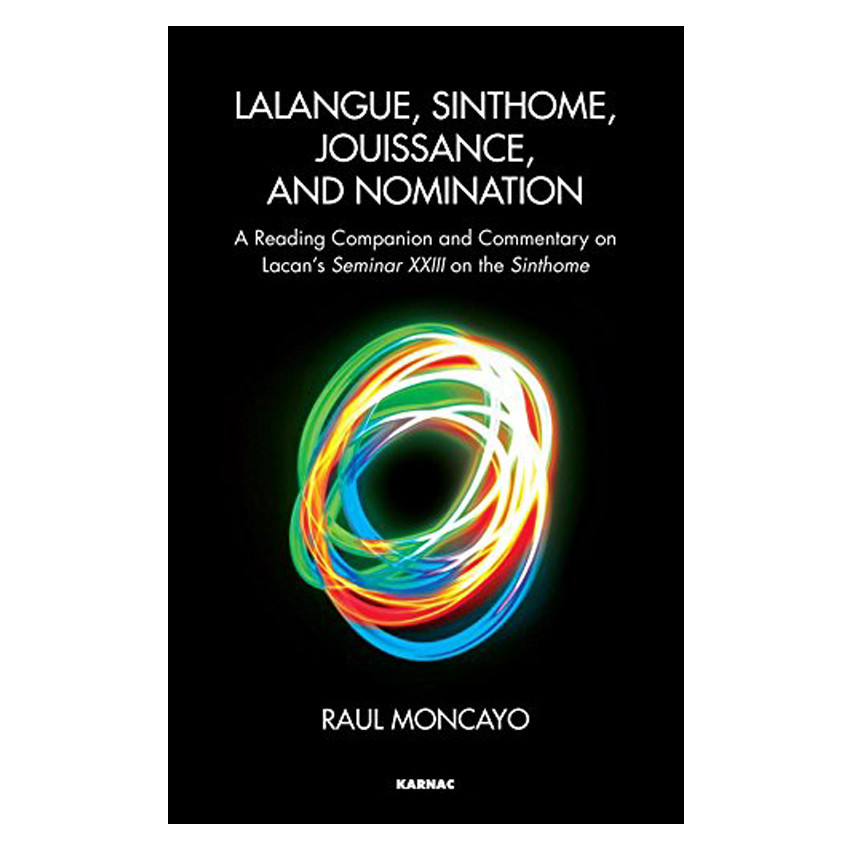
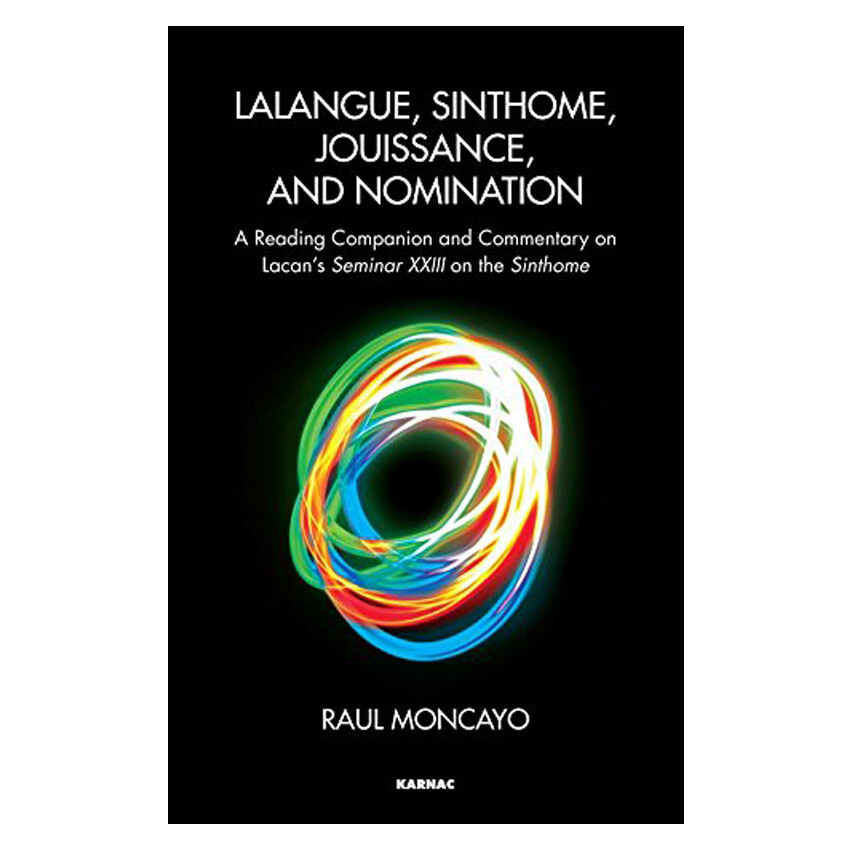 Lacan's Seminar XXIII on the Sinthome represents the culmination of a Seminar that spanned over two decades and represents an evolution of his thought where previous concepts are not abandoned but rather recontextualized within the context of new theory. As the topological knot of three represents the first theory presided by the Symbolic, the knot of four represents the final theory presided by the Real and a new conception of the symptom. Until recently Seminar XXIII was only available in English thanks to Cormac Gallagher unofficial translation, but now the official translation has been published as well as Raul Moncayo's commentary on the same.
Raul Moncayo is supervising analyst, founding member, and faculty of the San Francisco Bay Area Lacanian School of Psychoanalysis (LSP). He has a private practice of psychoanalysis, psychotherapy, supervision, and consultation. Dr. Moncayo has published five books and many papers in professional journals and has over thirty years of clinical experience including being training director for many years of a large psychiatric clinic in San Francisco and being faculty at many universities both locally and internationally. His latest work, Lalangue, Sinthome, Jouissance, and Nomination: A Reading Companion and Commentary on Lacan's Seminar XXIII on the Sinthome, is published by Karnac.
Dany Nobus is Professor of Psychoanalytic Psychology at Brunel University London, where he also convenes the MA Programme in Psychoanalysis and Contemporary Society. In addition, he is the Chair of the Freud Museum London, and the author of numerous publications on the history, theory and practice of psychoanalysis. In April 2017, he will be presented with the Sarton medal of the University of Ghent for his contributions to the history and theory of psychoanalysis, and this will coincide with the publication of a new book entitled The Law of Desire: On Lacan’s “Kant with Sade”.
Mar 3, 2017
Mar 3, 2017
1hr 25 min
Celebrity, Pornography and the Psychoanalysis of Self-Representation
Gareth Longstaff
Using the original concept of ‘Bodies that Stutter’ this paper focuses on the representational intersections between celebrity and pornography online.
To do this it will consider how contemporary practices of self-representation on digital and networked media (captured in the practice of the ‘selfie’) frame a rhetoric of desire as jouissance. The dialogue between queer and psychoanalytic theory will also inform the discussion to consider how performative bodies that have ‘mattered’ (Judith Butler, 1993) and unconsciously ‘muttered’ (Tim Dean, 2000) now ‘stutter’. Using the work of Jacques Lacan to reposition Tim Dean's and Judith Butler's concepts of bodies that matter and bodies that mutter, this stuttering body, which is embedded in late capitalist discourses of celebrity and pornography, is reflective of the hesitancy, frustration, exhilaration, and repetition that it subversively contains, as well as remaining vulnerable to metonymic contiguity and transposition of a symbolically normative language it cannot control. ‘Bodies that Stutter’ are also the bodies that attempt to express a powerful jouissance. through a language of the ‘personal’ and the metaphorical signifier. Yet, unlike Imaginary bodies that rely upon ego, the ‘Bodies that Stutter’ are subject to an impersonal Other that underpins how their desire is expressed metonymically – through this process they symbolically-stutter.
A lot like desire, or slips of the tongue and pen, stuttering is reliant upon stops and starts, structure and chaos, satisfaction and dissatisfaction. It is also something that cannot be contained or applied to one body above another or indeed one identity and/or identity type. This paper uses the contextual focus of the micro-celebrity selfie and its ubiquity on social networking sites to suggest that bodies that stutter form a practice of ‘symbolic stuttering’ that might well occur in multiple, ambiguous, and oblique ways.
Gareth Longstaff is a lecturer in media and cultural studies at Newcastle University. Both his teaching and research interests are primarily concerned with queer sexuality, celebrity, discourses of self-representation, pornography and psychoanalysis. Gareth works at the intersection of how these are connected to other dimensions of queer, cultural, philosophical, mediated and social life and in his upcoming monograph ‘Bodies that Stutter: Celebrity, Pornography and the Psychoanalysis of Self Representation’ his approach to these issues engages and applies queer theory and crossing of Freudian and Lacanian psychoanalysis to the impersonality of desire and the mediated screening of the self in self-representational photography, pornography/sexual representation, and digital / networked media.
Jan 3, 2017
Jan 3, 2017
59 min
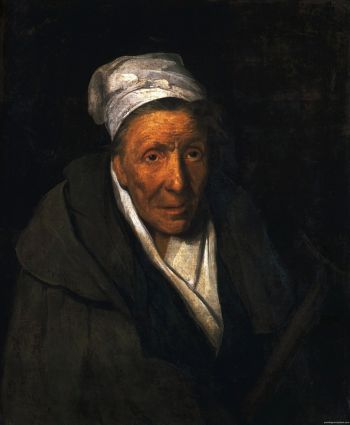
Analytic psychotherapist and art historian, Robert Snell joins us to discuss his forthcoming book, Portraits of the Insane: Théodore Géricault and the Subject of Psychotherapy.
In the gloomy aftermath of the 1789 Revolution and the Napoleonic wars, the French painter Théodore Géricault (1791–1824) made a series of portraits of patients in an asylum or clinic. The paintings are unprecedented: they show people designated as insane as ordinary, unique individuals. They point to a new, essentially democratic conception of the human being, sane or mad, as available for relationship and communication: a ‘therapeutic subject’. Made during a period of massive social, cultural, and economic transformation, they register a critical moment in the history of subjectivity, and connect us to some living roots of psychoanalysis.They challenge us profoundly, in our own conflicted era, to find responses in ourselves to the stranger in our midst.
‘The scope of this book is remarkable. Robert Snell’s meditation on five portraits of mad people by Géricault is the springboard for a fascinating cultural investigation. He surveys two centuries of change in the understanding of human nature, and considers how this is reflected in changing approaches to the treatment of madness.The breadth and depth of scholarship on offer here is exceptional, and this admirable book is an object lesson in the relation of psychoanalysis to the history of ideas.’ — Michael Parsons, British Psychoanalytical Society and French Psychoanalytic Association
Robert Snell is an analytic psychotherapist and art historian, a member of the British Psychotherapy Foundation, and an Honorary Senior Research Fellow in the Centre for Therapeutic Education at Roehampton University.
Dec 22, 2016
Dec 22, 2016
1hr 9 min
Karin Nohr and Sebastian Leikert: Dr Kundry's Failure
The first part of this lecture sets out to investigate reasons for the well-known fact that Wagner's music and in particular his opera Parsifal evokes divergent feelings and promotes polarization among the audience. After exploring the semantic system of music which Leikert calls ‘kinaesthetical’, three principles are put forth that organize it: repetition, seduction, ritualization. Whereas religious ritualization is conservative and norm-orientated, the ethical orientation of art is creative and encourages the subject to broaden in autonomy and in the recognition of their inner world including their conflicts and the tragic aspects of life. The second part of the lecture discusses the question, if and how Wagner in Parsifal contributes to this progressive aim by analyzing the composer’s concept of empathy (Mitleid) and focusing on the Parsifal-Kundry relationship.
Karin Nohr was born in Hamburg, Germany, where she studied literature and psychology. For 20 years she worked as a psychoanalyst and lecturer focusing on the use of imagination in the therapeutic process (book publication: Bahrke, Nohr, Katathym Imaginative Psychotherapie. Lehrbuch der Arbeit mit Imaginationen in psychodynamischen Psychotherapien. Springer 2013) Having all her life played a musical instrument and having completed her training in classical singing, she wrote her Masters’ Thesis on the inner concepts musicians develop of their musical instruments (book publication: Karin Nohr, Der Musiker und sein Instrument. Tübingen, edition diskord 1997, Reprint Psychosozialverlag 2010). Many publications on both themes were to follow, among them one on Tristan and Isolde by Richard Wagner. Karin Nohr was a founding member of the German Society for Psychoanalysis and Music (www.psychoanalyse-und-musik.de); she has been on the board of this association ever since and been responsible for two annual conferences. Since 2010 she has stopped clinical work and has turned to novel writing. Her publications include: Herr Merse bricht auf. Knaus (Random House 2012) and Vier Paare und ein Ring (Knaus 2013). Both novels have been reprinted as pocket books. She lives in Berlin and in Dünsche/Wendland.
Dr Sebastian Leikert is a practicing Psychoanalyst and Training Analyst based in Saarbrücken in Germany. His main research interests include the psychoanalysis of music and the relationship between aesthetical and psychical processes. His recent publications include ‘Beauty and Conflict – Outline of a General Psychoanalytic Aesthetics’ (2012) and, as editor, ‘On the Psychoanalysis of the Aesthetical Process in Music, Cinema and Painting’ (2015). His article, written for the International Journal of Psychoanalysis entitled, ‘For Beauty is nothing but the barely endurable onset of Terror’ – outline of a general psychoanalytic aesthetics’ is forthcoming. He is also the Chairman and co-founder of the German Society for Psychoanalysis and Music.
In our conference 'Wagner, Freud and the End of Myth' (2013) we argued that by taking the mythic dimension and bringing it into the human realm, Wagner anticipated Freud in his depiction of unconscious processes of the mind. It could be said that Freud and Wagner were dealing with the same stuff - the “fundamental psychosexual issues that affect us all” as Barry Millington put it, and for that reason a fruitful dialogue can exist between their two bodies of work.
The present conference is entirely devoted to Wagner’s final masterpiece, Parsifal, and explores whether this sublime, troubling and contentious work prefigures psychoanalytic insight or resists psychoanalytic interpretation. As a story of compassion and redemption, which nevertheless describes a world of perversion and mental anguish, what can Parsifal tell us about the secret springs of human desire and the conflicts of human nature? And how did Wagner manage to create it?
Dec 22, 2016
Dec 22, 2016
19 min
Patrick Carnegy in conversation with Robert Lloyd
Since he first visited Bayreuth in 1967 as music critic for The Times, Patrick Carnegy's principal research interest has been the stage history of Wagner's works. He was the first person to be appointed Dramaturg (literary and production adviser) at the Royal Opera House, Covent Garden. His interests also include Shakespeare and he was Stratford-upon-Avon theatre critic for The Spectator from 1998 - 2013. Dr Carnegy's books include Faust as Musician (1973), a study of Thomas Mann's Doktor Faustus, and Wagner and the Art of the Theatre (2006) which won a Royal Philharmonic Society Music Award, and in the USA a George Freedley Memorial Award for its 'outstanding contribution to the history of the theatre'. His current work is on Wagner's indebtedness to Shakespeare, on which subject he is lecturing at home and abroad as a contribution to the 400th anniversary of the playwright's death.
In our conference 'Wagner, Freud and the End of Myth' (2013) we argued that by taking the mythic dimension and bringing it into the human realm, Wagner anticipated Freud in his depiction of unconscious processes of the mind. It could be said that Freud and Wagner were dealing with the same stuff - the “fundamental psychosexual issues that affect us all” as Barry Millington put it, and for that reason a fruitful dialogue can exist between their two bodies of work.
The present conference is entirely devoted to Wagner’s final masterpiece, Parsifal, and explores whether this sublime, troubling and contentious work prefigures psychoanalytic insight or resists psychoanalytic interpretation. As a story of compassion and redemption, which nevertheless describes a world of perversion and mental anguish, what can Parsifal tell us about the secret springs of human desire and the conflicts of human nature? And how did Wagner manage to create it?
Dec 22, 2016
Dec 22, 2016
47 min
Patrick Carnegy: Syberberg's Parsifal and the soul of Germany
Hans Jürgen Syberberg's 1982 film of Parsifal is a psychological exploration of the opera, its roots in Wagner's mind, and its historical afterlife. Abstracted from Amfortas's body, his wound, carried about on a cushion by two female pages, becomes a symbol of Germany's unassuaged shame and guilt, an object of fascination and horror until it can be healed. When Kundry's kiss awakens Parsifal's sexuality, Syberberg sensationally replaces the male hero by a female Parsifal. His idea, in Jungian terms, is that the animus cannot itself complete the therapeutic journey through the psychic labyrinth, for this is given only to the anima, which here also embodies the soul of Germany. Patrick Carnegy offers some reflections on the wondrous complexity and resonance of this brilliant film.
Since he first visited Bayreuth in 1967 as music critic for The Times, Patrick Carnegy's principal research interest has been the stage history of Wagner's works. He was the first person to be appointed Dramaturg (literary and production adviser) at the Royal Opera House, Covent Garden. His interests also include Shakespeare and he was Stratford-upon-Avon theatre critic for The Spectator from 1998 - 2013. Dr Carnegy's books include Faust as Musician (1973), a study of Thomas Mann's Doktor Faustus, and Wagner and the Art of the Theatre (2006) which won a Royal Philharmonic Society Music Award, and in the USA a George Freedley Memorial Award for its 'outstanding contribution to the history of the theatre'. His current work is on Wagner's indebtedness to Shakespeare, on which subject he is lecturing at home and abroad as a contribution to the 400th anniversary of the playwright's death.
In our conference 'Wagner, Freud and the End of Myth' (2013) we argued that by taking the mythic dimension and bringing it into the human realm, Wagner anticipated Freud in his depiction of unconscious processes of the mind. It could be said that Freud and Wagner were dealing with the same stuff - the “fundamental psychosexual issues that affect us all” as Barry Millington put it, and for that reason a fruitful dialogue can exist between their two bodies of work.
The present conference is entirely devoted to Wagner’s final masterpiece, Parsifal, and explores whether this sublime, troubling and contentious work prefigures psychoanalytic insight or resists psychoanalytic interpretation. As a story of compassion and redemption, which nevertheless describes a world of perversion and mental anguish, what can Parsifal tell us about the secret springs of human desire and the conflicts of human nature? And how did Wagner manage to create it?
Dec 22, 2016
Dec 22, 2016
23 min
Tom DeRose: Wagner, Freud and Nietzsche in Berlin
With reference to Dmitri Tcherniakov’s recent Berlin production, this paper will consider the relationship between the character of Gurnemanz in Wagner’s Parsifal and Nietzsche’s conception of the ascetic priest in On the Genealogy of Morals. Although Gurnemanz appears as an un-biased narrator, something akin to the Evangelist in a Bach Passion, just how far removed from the action is he? I will suggest that the insights of Freud and René Girard can help us to gain a deeper understanding not only of this ‘all knowing’ story-teller, but also of the violence which lies at the heart of social systems.
Tom DeRose is Volunteer Coordinator at the Freud Museum where he helps to organise conferences and runs the Freud Museum reading group. He studied History and Philosophy and has a longstanding interest in the operas of Richard Wagner.
In our conference 'Wagner, Freud and the End of Myth' (2013) we argued that by taking the mythic dimension and bringing it into the human realm, Wagner anticipated Freud in his depiction of unconscious processes of the mind. It could be said that Freud and Wagner were dealing with the same stuff - the “fundamental psychosexual issues that affect us all” as Barry Millington put it, and for that reason a fruitful dialogue can exist between their two bodies of work.
The present conference is entirely devoted to Wagner’s final masterpiece, Parsifal, and explores whether this sublime, troubling and contentious work prefigures psychoanalytic insight or resists psychoanalytic interpretation. As a story of compassion and redemption, which nevertheless describes a world of perversion and mental anguish, what can Parsifal tell us about the secret springs of human desire and the conflicts of human nature? And how did Wagner manage to create it?
Dec 22, 2016
Dec 22, 2016
51 min
Mark Berry: Interpreting Wagner’s Dreams: Staging Parsifal in the Twenty-First Century
Parsifal, like all of Wagner’s dramas, has much to tell us at the intersection of authorial intention and latent content. What is revealed and what is repressed? Dreams were certainly of great importance to Wagner, perhaps most famously in his claim that the Prelude to Das Rheingold had come to him in ‘a kind of somnambulistic state … the feeling of being immersed in rapidly flowing water,’ and indeed in the dramatic material of a number of his works. Die Meistersinger von Nürnberg is explicitly concerned with the formation of an artwork initially revealed in a dream world. That offers an interesting way to consider stagings of his works too, and their claims to fidelity or otherwise at a textual or allegedly ‘deeper’ level. I shall consider the work ‘itself’ and its adamant claim to stand apart from the operatic repertoire as a Bühnenweihfestspiel (‘stage-festival-consecration-play’) to be confined to his artistic temple at Bayreuth. I shall also consider two particular productions: Stefan Herheim (Bayreuth, 2008-12) and Dmitri Tcherniakov (Berlin, 2015-). How do directors and performers navigate the historical, social, cultural, and psychological distances and conflicts between Wagner’s intentions, his ability and inability to fulfil and perhaps even to transcend those intentions, and the needs of contemporary theatres and audiences? What is gained and what is lost? What, again, is revealed and what is repressed?
Dr Mark Berry is Senior Lecturer in Music at Royal Holloway, University of London. He read History at the University of Cambridge, where he remained for postgraduate and postdoctoral study. He is the author of Treacherous Bonds and Laughing Fire: Politics and Religion in Wagner’s Ring (Ashgate, 2006) and After Wagner: Histories of Modernist Music Drama from ‘Parsifal’ to Nono (Boydell Press, 2014) and has written widely on musical, intellectual, and cultural history from the later seventeenth century to the present day. He is at present writing a biography of Arnold Schoenberg for Reaktion Books and co-editing the Cambridge Companion to Wagner’s ‘Ring of the Nibelung’. He reviews concert and opera performances regularly, and is the author of the ‘Boulezian’ blog.
In our conference 'Wagner, Freud and the End of Myth' (2013) we argued that by taking the mythic dimension and bringing it into the human realm, Wagner anticipated Freud in his depiction of unconscious processes of the mind. It could be said that Freud and Wagner were dealing with the same stuff - the “fundamental psychosexual issues that affect us all” as Barry Millington put it, and for that reason a fruitful dialogue can exist between their two bodies of work.
The present conference is entirely devoted to Wagner’s final masterpiece, Parsifal, and explores whether this sublime, troubling and contentious work prefigures psychoanalytic insight or resists psychoanalytic interpretation. As a story of compassion and redemption, which nevertheless describes a world of perversion and mental anguish, what can Parsifal tell us about the secret springs of human desire and the conflicts of human nature? And how did Wagner manage to create it?
Dec 22, 2016
Dec 22, 2016
36 min
Eva Rieger: Kundry’s Kiss and the Fear of Female Desire: A Gender Perspective
“Wagner’s operas are largely dramas of incestuous feelings and urges” writes James M. McGlathery (in Wagner’s Operas and Desire). Lawrence Dreyfus has also made it clear that Wagner was obsessed with sexuality, and this obsession determined the composition of operas such as Tannhäuser, Walküre and Tristan and Isolde. In his opera Parsifal, Wagner creates a female character who shows active sexual desire, and then exorcises her qua Woman for precisely that reason. Whereas men can desire women, the opposite is regarded as dangerous. In previous works, Wagner gives women like Elsa, Brünnhilde, Elisabeth and Sieglinde the power to love in a “feminine” way, but unlike Kundry they do not think of sex. I will trace the role of Kundry as she was developed by Wagner from 1865 onwards, using the development of her role to deduce which characteristics of her personality were important to him. A further clue is given by the music which speaks to us and opens up psychological insights. With respect to the semi-religious content of Parsifal, I find that the idea of gender equality is jettisoned here, which means that one can debate whether Kundry’s death is the result of Wagner’s antisemitism or his antifeminism. Finally, the question arises why Wagner should condemn women’s sexuality in such a manner (and thereby condemn the women themselves), although he was dependent on the emotional and physical love of women throughout his life.
Eva Rieger was Professor of Musicology at the University of Bremen until 2000, when she moved to Vaduz, Liechtenstein. She has worked primarily on the issue of gender and musicology and written biographies of Nannerl Mozart, Minna Wagner and Friedelind Wagner. The latter was published in English (Boydell 2013), as was a study of the female roles in Richard Wagner's operas entitled Wagner’s Women (Boydell 2011). Her book on the singer Frida Leider will be published in 2016 (Frida Leider. Sängerin im Zwiespalt ihrer Zeit (Olms)).
In our conference 'Wagner, Freud and the End of Myth' (2013) we argued that by taking the mythic dimension and bringing it into the human realm, Wagner anticipated Freud in his depiction of unconscious processes of the mind. It could be said that Freud and Wagner were dealing with the same stuff - the “fundamental psychosexual issues that affect us all” as Barry Millington put it, and for that reason a fruitful dialogue can exist between their two bodies of work.
The present conference is entirely devoted to Wagner’s final masterpiece, Parsifal, and explores whether this sublime, troubling and contentious work prefigures psychoanalytic insight or resists psychoanalytic interpretation. As a story of compassion and redemption, which nevertheless describes a world of perversion and mental anguish, what can Parsifal tell us about the secret springs of human desire and the conflicts of human nature? And how did Wagner manage to create it?
Dec 22, 2016
Dec 22, 2016
40 min
Stephen Gee: Wagner’s Parsifal: A Hymn of Purity and Danger
Parsifal, the fool, is thrown out of an ailing religious community after witnessing a mysterious ritual of healing and purification, reluctantly officiated by a disgraced spiritual leader condemned to unremitting agony. In Act 11 he wanders into a magic garden, and almost gets involved in a sort of 19th century chemsex party. Alarmed by the sudden arousal of his desire and the prospect of endless enjoyment, he longs to return to the earlier scene of anguish and humiliation, which he begins to understand for the first time. A nostalgia for the sublime propels him back to the community of knights, where he is met by his penitent seductress, Kundry.
Wagner’s operas have provoked many great philosophers. Some, like Adorno, were hostile to what they saw as an ideological forerunner of 20th Century political catastrophes. Psychoanalysis raises another kind of intellectual challenge. Is Parsifal a menacing premonition of totalitarianism, or does it elaborate with unprecedented complexity the enigmatic after-effect of the trauma of human beings throughout history, who can never predict whether they will survive together in communities continually subverted by unconscious desires?
Stephen Gee is a member and former Chair of The Site for Contemporary Psychoanalysis. He has contributed to Site conferences on Winnicott, Lacan, Homosexuality, and Class. He organised a rehearsed reading of Sarah Kane's 4:48 Psychosis followed by a colloquium in which psychoanalysts of different schools talked about the issues raised by the play and the challenges facing people suffering with psychosis. He ran a performance group at the Studio Upstairs where he was also a supervisor. He is a member of the editorial group of the Site's psychoanalytic journal, and has written on the problematic history of psychoanalysis and homosexuality. He interviewed the director Phyllida Lloyd at The Site and at the English National Opera on her 2005 production of Wagner's Ring cycle. He has a private practice in South London and teaches regularly at The Site and on other psychoanalytic trainings.
In our conference 'Wagner, Freud and the End of Myth' (2013) we argued that by taking the mythic dimension and bringing it into the human realm, Wagner anticipated Freud in his depiction of unconscious processes of the mind. It could be said that Freud and Wagner were dealing with the same stuff - the “fundamental psychosexual issues that affect us all” as Barry Millington put it, and for that reason a fruitful dialogue can exist between their two bodies of work.
The present conference is entirely devoted to Wagner’s final masterpiece, Parsifal, and explores whether this sublime, troubling and contentious work prefigures psychoanalytic insight or resists psychoanalytic interpretation. As a story of compassion and redemption, which nevertheless describes a world of perversion and mental anguish, what can Parsifal tell us about the secret springs of human desire and the conflicts of human nature? And how did Wagner manage to create it?
Dec 22, 2016
Dec 22, 2016
50 min
Tom Artin: Primal Scene/Primal Wound: The psychoanalytic arc of Parsifal
After they have witnessed the scarlet-suffused ritual revealing the Grail in Act I, Gurnemanz poses to Parsifal the primal question: Weißt du was du sahst? Do you know what you saw? This question is an enigma whose solution becomes the goal of the “pure fool’s” arduous quest. The answer, we will discover, is the primal scene, which, in Act II, is experienced by our hero not just vicariously, but in the flesh viscerally and shatteringly in Kundry’s passionate embrace. “Amfortas! The wound!” Parsifal cries out in retreat from the brink of penetration. In that sudden insight, he is overwhelmed by the reality of the castration threat lurking at the heart of every primal scene. The emotional sequelae following upon erotic enlightenment—guilt, remorse, compassion, and finally absolution—constitute the measured denouement of Parsifal, which culminates in a fantasy of redemption and the illusory resolution of primal anxiety.
Tom Artin is the author most recently of What Parsifal Saw. A previous book, The Wagner Complex; Genesis and Meaning of The Ring, was presented at the Freud Museum’s Freud/Wagner conference in 2013. He has lectured on this book to Richard Wagner Societies in the United States, Austria, and Germany. Other books are The Allegory of Adventure: Reading Chrétien’s Erec and Yvain, and Earth Talk: Independent Voices on the Environment. Artin holds both a B.A. in English Literature, and a Ph D. in Comparative Medieval Literature from Princeton University.
In our conference 'Wagner, Freud and the End of Myth' (2013) we argued that by taking the mythic dimension and bringing it into the human realm, Wagner anticipated Freud in his depiction of unconscious processes of the mind. It could be said that Freud and Wagner were dealing with the same stuff - the “fundamental psychosexual issues that affect us all” as Barry Millington put it, and for that reason a fruitful dialogue can exist between their two bodies of work.
The present conference is entirely devoted to Wagner’s final masterpiece, Parsifal, and explores whether this sublime, troubling and contentious work prefigures psychoanalytic insight or resists psychoanalytic interpretation. As a story of compassion and redemption, which nevertheless describes a world of perversion and mental anguish, what can Parsifal tell us about the secret springs of human desire and the conflicts of human nature? And how did Wagner manage to create it?
Aug 5, 2016
Aug 5, 2016
1hr 11 min
The Journeys of Anna Freud's Alpine Furniture
In conjunction with the Austrian Cultural Forum
Nine decorated chests and cupboards of Alpine origin stand in today’s Freud Museum. Anna Freud bought this rustic furniture in 1930 and used it to furnish the country house in the Vienna Woods which she shared with Dorothy Burlingham. When the Freuds fled Vienna in 1938 Dorothy Burlingham sent the furniture to the US. After the war this furniture returned to Europe, to the new summer house that Anna and Dorothy had bought in Walberswick on the east coast of England, and from there back to London, to Maresfield Gardens.
This year this much travelled furniture has formed the starting point for an exhibition at the Austrian Museum of Folk Life and Folk Art in Vienna, recreated through digital photography in the museum’s permanent display of similar pieces. These images transfer Anna Freud’s furniture back to Vienna, playing with ideas of remembering, place and time. The displays connect the Vienna of then and now with the London of yesterday and today, bringing the present together with the past.
This talk adds another layer to this complex story, bringing the exhibit from Vienna – the recreation of Anna Freud’s furniture – back to London, and reunites the recreated versions with the originals.
The exhibition curator Birgit Johler explores the story of the furniture in Freud’s Dining Room and how she created this extraordinary and innovative exhibition.
She is joined in the discussion by:
Anne-Marie Sandler, psychoanalyst, Director of the Anna Freud Centre from 1993 -1996, friend and colleague of Anna Freud
Bettina von Zwehl, Artist in residence, Anna Freud project 2013-14, and exhibiting at the Freud Museum June-July 2016
Carol Seigel, Director, Freud Museum London
Aug 2, 2016
Aug 2, 2016
1hr 8 min
Jul 19, 2016
Jul 19, 2016
1hr 11 min
Lament: Bettina von Zwehl in conversation with Josh Cohen
Lament is a new publication by Art/Books, which features two series of images by artist Bettina von Zwehl with new writing by psychoanalyst Josh Cohen. Cohen’s two texts are interwoven amongst the images, one a critical reflection on light and shadow, the other a poetic tale inspired by the torn photographs.
This evening they will discuss both the publication and von Zwehl’s exhibition Invitation to Frequent the Shadows, on display at the Museum 7 June – 17 July 2016.
Lament is published by Art/Books (July, 2016). Available from the Museum shop.
Bettina von Zwehl lives and works in London. She has an MA Fine Art Photography from the Royal College of Art and BA (Hons) Photography from the London College of Printing. Recent solo exhibitions include Album 31, (with Sophy Rickett), 2015, Fotogaleriet, Oslo, Norway, touring to The Library of Birmingham, UK; Purdy Hicks, London (2014 and 2011); Road to 2012, Setting Out, commissioned by National Portrait Gallery, London, 2010; and The Photographers’ Gallery, 2005. Group exhibitions include Facing Histories, Victoria and Albert Museum, London, 2015; Seduced by Art: Photography Past and Present, National Gallery, London and touring to Fundacio La Caixa, Madrid, Spain, 2012 and In Repose, The Galleries at Moore, Philadelphia El Cuerpo (con) sentido: una (re)presentación visual, Centro de Historia, Zaragosa, 2008. Her work is held in many collections including Arts Council, London; British Council, London; Sammlung Spallart, Salzburg, Austria; Guggenheim, New York and Mint Museum, Charlotte, North Carolina, USA.
Josh Cohen is a practising psychoanalyst and Professor of Modern Literary Theory at Goldsmiths, University of London. He is the author of The Private Life: Why We Remain in the Dark (2013), which won the BMA Board of Science Chair’s Choice Award for 2014 and was longlisted for the JQ/Wingate Literary Award, How to Read Freud (2005), Interrupting Auschwitz: Art, Religion, Philosophy (2003) and Spectacular Allegories: Postmodern American Writing and the Politics of Seeing (1998). He writes regularly for the TLS, Guardian, Prospect and New Statesman and is a Fellow of the British Psychoanalytical Society.
Jul 19, 2016
Jul 19, 2016
51 min
Building on research from my recent book Art and the Home: Comfort, Alienation and the Everyday, this talk will consider how post-war sculptors have addressed ideas of the domestic uncanny. In order for these works to have resonance viewers needs to empathetically engage, and allow for a blurring between consciousness and the material world. They project onto the objects and installations their own understanding of reality.
Freud wrote about how relationships with the world and society are veiled by customs and accepted ideas of normality. His essay ‘The Uncanny’ discussed how feelings of dread and unease could be conjured and felt. This was influential with surrealist artists, but what will be discussed here are artists working later, but who show influence of those ideas, including Louise Bourgeois, Mona Hatoum and Gregor Schneider.
Art and the Home: Comfort, Alienation and the Everyday is published by I.B.Tauris (January, 2015). Available from the Museum shop.
Dr Imogen Racz is Senior Lecturer in the History of Art at Coventry University. She has published two books and written many articles. Her recent book Art and the Home; Comfort, Alienation and the Everyday, (I. B. Tauris 2015) is a thematic investigation into how post-war artists interpreted the abstract concepts that we have about the home, including enclosure, alienation, sentiment, female space, and the unmade house. Her current research has been focusing on the sculptor and photographer Helen Chadwick, placing her work of the 1980s into its artistic, theoretical and social contexts. This forms part of a larger, ongoing exploration of 1980s sculptural practices in Britain, especially that of women artists.
Jun 21, 2016
Jun 21, 2016
31 min
This presentation locates understanding of psychosis from an attachment perspective within its historical context, present concerns about the treatment of the mentally ill and explores how attachment theory can inform future understanding of the mentally ill. Disorganised attachment is argued to be intimately linked with psychosis despite Bowlby’s early modesty about how attachment theory could inform our understanding of psychosis. Attachment theory’s stress on the importance of grief, separation, trauma and violence are highlighted as causal factors in the aetiology of mental illness, and important issues to address as part of the healing or recovery. The experience of psychosis are conceptualised within their relational and social context, and therapeutic relationships and social change are proposed as being the treatments of choice.
Kate Brown is a Bowlby Centre trained UKCP registered attachment based psychoanalytic psychotherapist who started her career in therapeutic communities working with adults with a variety of mental health difficulties, and with adolescents individually and in groups. She has worked with young mothers and in mainstream community psychiatric services with patients’ families. She has also provided time limited therapy with former servicemen who had experienced complex trauma. She teaches at The Bowlby Centre and has also delivered freelance training. Kate completed an MSc in psychotherapeutic approaches in mental health in 2012. She is a member of the Attachment Journal editorial group, former chair of the clinical forum at The Bowlby Centre. Kate has recently begun a PhD in the psychoanalysis department at Middlesex University in the history of the therapeutic community movement and the treatment of trauma. Kate has recently moved to Bournemouth where she will be developing a private practice.
Jun 20, 2016
Jun 20, 2016
23 min
In the period following the end of the second world war in Britain, Kleinian psychoanalysis rapidly established itself as an influential paradigm for the treatment and understanding of the psychoses, within both psychoanalytical and medically minded psychiatric circles. Medically qualified psychoanalysts such as Hanna Segal, Herbert Rosenfeld and Wilfred Bion all made seminal contributions and the institutional approval and establishment ratification of their work, continues to be strongly felt to this day. In this paper, we will take up some arguments from the Canadian philosopher of science Ian Hacking, in order to look again at the tightly prescribed clinical techniques of Kleinian psychoanalysis of the period, especially in terms of the relationship between the social conditions of their analytic frame and the kind of theory of the psychoses this frames enables. In the twenty-first century, as we continue to battle to understand and provide effective treatments for those experiencing severe emotional distress, this paper hopes to remind us of the sensitive connection between the way in which we build theories of the mind out of the way we work with our patients and, in turn, the effect these theories have on those who seek our help.
Barry Watt is a psychoanalyst in private practice and a member of the SITE for Contemporary Psychoanalysis. He is one of the senior practitioners at the Psychosis Therapy Project as well as a housing advocate and community activist.
From the 'Psychosis and Psychoanalysis', a conference organised in collaboration with the Psychosis Therapy Project, a therapy service for people experiencing psychosis.
Jun 13, 2016
Jun 13, 2016
1hr 27 min
Jun 7, 2016
Jun 7, 2016
1hr 33 min
This afternoon’s symposium explores how artists and writers use the creative process to face and work through traumatic and painful experiences of loss.
Part 2: Fay Ballard, artist, in conversation with writer Jeremy Gavron, author of A Woman on the Edge of Time, discussing how the early and unexpected deaths of their mothers – Fay’s of a sudden acute illness, Jeremy’s by suicide – has had a profound influence on their lives and work.
Chaired by Esther Dreifuss-Kattan.
The death of her mother in 1964 when Fay was seven, and of her father, the novelist J G Ballard, in 2009, became the catalyst for major change in her work. Clearing the family home, Fay began to draw her mother from discovered photos as well as family possessions which evoked strong memories. These drawings were exhibited in ‘House Clearance’ at Eleven Spitalfields Gallery, London in 2014, at & Model Gallery Leeds in 2015 alongside new work.
A Woman on the Edge of Time is Jeremy Gavron’s moving memoir of his mother, Hannah Gavron, who committed suicide in 1965 when he was only four. Bright, sophisticated, and swept up in the progressive politics of the 1960s, Hannah was a promising academic and the wife of a rising entrepreneur.
Searching for the mother who was never talked about as he grew up, Gavron discovers letters, diaries, and photos that paint a picture of a brilliant but complex young woman grappling to find an outlet for her creativity, sexuality, and intelligence. Piecing together the events that led to his mother's suicide, Gavron discovers that Hannah's success came at a price, and that the pressures she faced as she carved out her place in a man's world may have contributed to her death.
'I was mesmerised by Jeremy Gavron's extraordinary memoir of his mother ... It's one of those works that cross over into the real life so justly that all of life is better understood by it.' Ali Smith
About the book:
Art and Mourning: The role of creativity in healing trauma and loss, by Esther Dreifuss Kattan, Routledge 2016
Esther Dreifuss-Kattan explores the relationship between creativity and the work of self-mourning in the lives of 20th century artists and thinkers. The role of artistic and creative endeavours is well-known within psychoanalytic circles in helping to heal in the face of personal loss, trauma, and mourning.
In this book, Esther Dreifuss-Kattan analyses the work of major modernist and contemporary artists and thinkers through a psychoanalytic lens. In coming to terms with their own mortality, figures like Albert Einstein, Louise Bourgeois, Paul Klee, Eva Hesse and others were able to access previously unknown reserves of creative energy in their late works, as well as a new healing experience of time outside of the continuous temporality of everyday life.
Dreifuss-Kattan explores what we can learn about using the creative process to face and work through traumatic and painful experiences of loss. Art and Mourning will inspire psychoanalysts and psychotherapists to understand the power of artistic expression in transforming loss and traumas into perseverance, survival and gain.
Art and Mourning offers a new perspective on trauma and will appeal to psychoanalysts and psychotherapists, psychologists, clinical social workers and mental health workers, as well as artists and art historians.
Biographies:
Dr. Esther Dreifuss-Kattan is a psychoanalyst, psychotherapist and art therapist in private practice in Beverly Hills, California. Dr. Esther Dreifuss-Kattan is the President Elect of the New Center for Psychoanalysis in Los Angeles. She works with adults of all ages, adolescents and children. Given Dr. Dreifuss-Kattan’s own artistic background, she specializes in helping clients who are involved in various creative pursuits.
Dr. Dreifuss-Kattan’s second specialty is working with adult and paediatric cancer patients/survivors and their families as well as those with chronic pain. In addition to her private practice, she also works extensively with Los Angeles-based organizations devoted to treating those with illness.
She received her PhD in Psychoanalysis from the Southern California Institute of Psychoanalysis, now the New Center for Psychoanalysis, and earned another in Art Therapy and Psychooncology from the Union Institute in Cincinnati, Ohio.
Dr. Dreifuss-Kattan is currently a senior faculty member at the New Center for Psychoanalysis. Her published books and articles center on clinical practice, theory in psychoanalysis and art, art therapy and psychooncology. She lectures nationally and internationally.
Jane McAdam Freud MA RCA is a sculptor and multi-disciplinary artist educated at the Royal College of Art and is a recipient of the British Art Medal Scholarship in Rome. McAdam Freud exhibits internationally, holding twenty solo shows since 1996. Jane's work has been acquired for numerous Public Collections including the British Museum, V&A, National Gallery Archives, and the National Gallery of Greece.
Fay Ballard studied History of Art at Sussex University in the late 1970s and worked at the Museum of London, Royal Academy of Arts and Tate, where she was involved in the creation of Tate Modern. She completed an MA Fine Art at Central Saint Martin’s in 2006.
Commissioned by The Prince of Wales to paint flora at Highgrove, her plant portraits have been exhibited widely. Fay was elected to the Royal Watercolour Society in 2007 and served as a trustee of Camden Arts Centre and the Victoria Miro Education Trust.
Fay is a member of the Drawing Room Professional Network. She teaches, most recently, at the RCA and Camberwell Art School.
Jeremy Gavron is the author of two non-fiction books and three novels, including The Book of Israel, winner of the Encore Award, and An Acre of Barren Ground. A former foreign correspondent in Africa and India, he lives now in London, and teaches at Warren Wilson College in North Carolina.
Jun 7, 2016
Jun 7, 2016
50 min
This symposium explores how artists and writers use the creative process to face and work through traumatic and painful experiences of loss.
Although a great inspiration to her and a regular presence in her childhood, Jane’s father Lucian Freud became only an occasional figure in his daughter’s life as she grew up; when Jane was eight years old, father and daughter lost contact, only to reconnect when Jane was 31. By then she was respected artist herself, having established a reputation as a sculptor under the name of Jane McAdam. By the end of Lucian’s life they were in regular contact. Jane says: ‘At that time I saw my father regularly and, over about six months, we made sculpture. The last time I saw my father was shortly before his death, when I finished the sketches of him. I’ve now used them to make a large portrait sculpture. It helps me to keep him alive’.
About the book:
Art and Mourning: The role of creativity in healing trauma and loss, by Esther Dreifuss Kattan, Routledge 2016
Esther Dreifuss-Kattan explores the relationship between creativity and the work of self-mourning in the lives of 20th century artists and thinkers. The role of artistic and creative endeavours is well-known within psychoanalytic circles in helping to heal in the face of personal loss, trauma, and mourning.
In this book, Esther Dreifuss-Kattan analyses the work of major modernist and contemporary artists and thinkers through a psychoanalytic lens. In coming to terms with their own mortality, figures like Albert Einstein, Louise Bourgeois, Paul Klee, Eva Hesse and others were able to access previously unknown reserves of creative energy in their late works, as well as a new healing experience of time outside of the continuous temporality of everyday life.
Dreifuss-Kattan explores what we can learn about using the creative process to face and work through traumatic and painful experiences of loss. Art and Mourning will inspire psychoanalysts and psychotherapists to understand the power of artistic expression in transforming loss and traumas into perseverance, survival and gain.
Art and Mourning offers a new perspective on trauma and will appeal to psychoanalysts and psychotherapists, psychologists, clinical social workers and mental health workers, as well as artists and art historians.
Biographies:
Dr. Esther Dreifuss-Kattan is a psychoanalyst, psychotherapist and art therapist in private practice in Beverly Hills, California. Dr. Esther Dreifuss-Kattan is the President Elect of the New Center for Psychoanalysis in Los Angeles. She works with adults of all ages, adolescents and children. Given Dr. Dreifuss-Kattan’s own artistic background, she specializes in helping clients who are involved in various creative pursuits.
Dr. Dreifuss-Kattan’s second specialty is working with adult and paediatric cancer patients/survivors and their families as well as those with chronic pain. In addition to her private practice, she also works extensively with Los Angeles-based organizations devoted to treating those with illness.
She received her PhD in Psychoanalysis from the Southern California Institute of Psychoanalysis, now the New Center for Psychoanalysis, and earned another in Art Therapy and Psychooncology from the Union Institute in Cincinnati, Ohio.
Dr. Dreifuss-Kattan is currently a senior faculty member at the New Center for Psychoanalysis. Her published books and articles center on clinical practice, theory in psychoanalysis and art, art therapy and psychooncology. She lectures nationally and internationally.
Jane McAdam Freud MA RCA is a sculptor and multi-disciplinary artist educated at the Royal College of Art and is a recipient of the British Art Medal Scholarship in Rome. McAdam Freud exhibits internationally, holding twenty solo shows since 1996. Jane's work has been acquired for numerous Public Collections including the British Museum, V&A, National Gallery Archives, and the National Gallery of Greece.
Fay Ballard studied History of Art at Sussex University in the late 1970s and worked at the Museum of London, Royal Academy of Arts and Tate, where she was involved in the creation of Tate Modern. She completed an MA Fine Art at Central Saint Martin’s in 2006.
Commissioned by The Prince of Wales to paint flora at Highgrove, her plant portraits have been exhibited widely. Fay was elected to the Royal Watercolour Society in 2007 and served as a trustee of Camden Arts Centre and the Victoria Miro Education Trust.
Fay is a member of the Drawing Room Professional Network. She teaches, most recently, at the RCA and Camberwell Art School.
Jeremy Gavron is the author of two non-fiction books and three novels, including The Book of Israel, winner of the Encore Award, and An Acre of Barren Ground. A former foreign correspondent in Africa and India, he lives now in London, and teaches at Warren Wilson College in North Carolina.
May 26, 2016
May 26, 2016
1hr 9 min
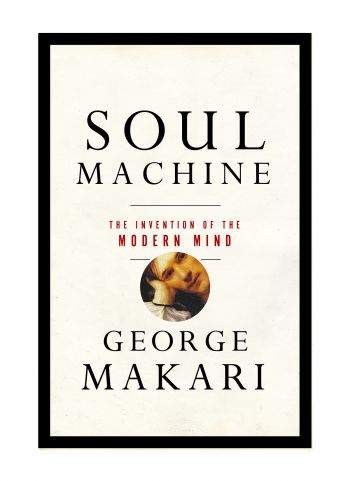
George Makari, author of the international acclaimed Revolution in Mind: The Creation of Psychoanalysis, discusses his latest publication, a brilliant and comprehensive history of the creation of the modern Western mind.
Soul Machine takes us back to the origins of modernity, a time when a crisis in religious authority and the scientific revolution led to searching questions about the nature of human inner life. This is the story of how a new concept―the mind―emerged as a potential solution, one that was part soul and part machine, but fully neither.
In this groundbreaking work, award-winning historian George Makari shows how writers, philosophers, physicians, and anatomists worked to construct notions of the mind as not an ethereal thing, but a natural one. From the ascent of Oliver Cromwell to the fall of Napoleon, seminal thinkers like Hobbes, Locke, Diderot, and Kant worked alongside often-forgotten brain specialists, physiologists, and alienists in the hopes of mapping the inner world. Conducted in a cauldron of political turmoil, these frequently shocking, always embattled efforts would give rise to psychiatry, mind sciences such as phrenology, and radically new visions of the self. Further, they would be crucial to the establishment of secular ethics and political liberalism. Boldly original, wide-ranging, and brilliantly synthetic, Soul Machine gives us a masterful, new account of the making of the modern Western mind.
"George Makari's brilliant, compendious "Soul Machine: The Invention of the Modern Mind" is essential reading. The story he tells so engagingly is of a vast, polyphonic argument about what it is to be a human being."
- The Wall Street Journal
"In 'Soul Machine,' George Makari presents an electrifying narrative of the intellectual debates that gave rise to the Western conception of the mind."
- The Economist
George Makari's Revolution in Mind: The Creation of Psychoanalysis was published in 2008 to international acclaim. Makari is the director of the DeWitt Wallace Institute for the History of Psychiatry, professor of psychiatry at Weill Medical College of Cornell University, and adjunct professor at both Rockefeller University and Columbia University's Psychoanalytic Center. He lives in New York City.
May 12, 2016
May 12, 2016
1hr 1 min
In this lecture Professor Naomi Segal explores the pleasures and pitfalls of translation, particularly translating psychoanalysis, and introduces the life and work of French psychoanalyst Didier Anzieu.
The lecture will be followed by the launch and drinks reception for The Skin-ego, Didier Anzieu, tr. Naomi Segal, with introductions from Estela Welldon and Dr Andrew Asibong.
Translating Anzieu: This paper is in two parts. The first introduces the principles, pleasures & realities of translation, and of translating psychoanalysis in particular. Are all translators murderers, pests or parasites? Are they trustworthy or traitors, or even ‘faithful bigamists’? Might translation be a feminine/feminised activity because most translators are women, or because the target -language has to be maternal, or because it embodies the irony of the multi-skilled serving the mono-skilled? The second part introduces the life and work of Didier Anzieu. The Skin-ego is the theory of a ‘vast metaphor’ based on ‘a paradox: the centre is situated at the periphery’. Freud’s image of the ego as ‘the projection of a surface’ is comprehensively developed, and the sense of touch is ‘not only placed at the origin of the psyche but shown to provide the latter permanently with what might also be called the mental backcloth, the ground upon which psychical contents are inscribed as figures, or the containing wrapping that makes it possible for the psychical apparatus to have contents’.
Didier Anzieu (1923–1999) was a French psychoanalyst and theorist whose work brings the body back to the centre of psychoanalytic enquiry. He was the author of numerous books and articles, on areas ranging from the psychology of groups and psychodrama to theories of creativity and thought; he also published short stories, literary criticism, a drama, a book of cartoons and a study of May ‘68 written from the heart of Nanterre. His research was always conducted alongside his academic and clinical practice, both characterised by inclusivity, curiosity, a broad mind and a gentle manner. Anzieu’s major work, Le Moi-peau [The Skin-ego], a psychoanalytic theory focused on the psychical skin, is presented here in a new English translation.
Naomi Segal is a professor of modern languages, specialising in comparative literary and cultural studies, gender, psychoanalysis and the body. In 2004 she created and then directed the Institute of Germanic & Romance Studies, University of London. She has published 15 books, of which the most recent monographs are Consensuality: Didier Anzieu, gender and the sense of touch (2009), André Gide: Pederasty and Pedagogy (1998) and The Adulteress’s Child: authorship and desire in the nineteenth-century novel (1992). Naomi Segal is an Academic Associate of the British Psychoanalytical Society, a Chevalier dans l'Ordre des Palmes académiques and a Member of the Academia Europaea.
Estela Welldon is a psychoanalytical psychotherapist who worked for three decades at the Tavistock Portman Clinics NHS Trust. She is founder and Honorary President for life of the International Association for Forensic Psychotherapy, a Fellow of the RCPsych, a Senior Member of the BAP, BPC and of the CBF. She is an honorary member of the IGA and of the SCPP, Tavistock Clinic. In 1997 she was awarded a D.Sc. (Honorary Doctorate of Science) degree by Oxford Brookes University. In 2014, she became an Honorary member of the American Psychoanalytic Association for her work in helping to understand women who harm children. Her most recent book is Playing with Dynamite (Karnac, 2011). She is the author of Mother, Madonna Whore: The Idealization and Denigration of Motherhood (1988).
Dr Andrew Asibong is Reader in Film and Cultural Studies at Birkbeck, University of London, where he has worked since 2006. He read Modern Languages at Oxford University, and carried out his doctoral research on stigma and metamorphosis in French literature and film at King's College London. He is co-director of the research centre Birkbeck Research in Aesthetics of Kinship and Community, co-editor of the journal Studies in Gender and Sexuality and former convenor of the Psychoanalysis Working Group at Birkbeck. Recent publications include Marie NDiaye: Blankness and Recognition (Liverpool: Liverpool University Press, 2013) and ‘"Then look!”: un-born attachments and the half-moving image’, Studies in Gender and Sexuality (16:2), 2015.
May 10, 2016
May 10, 2016
43 min
Iain Sinclair introduced by Michael Molnar - a 30th anniversary event
Join us for the latest in a special series of talks and lectures marking the Museum's 30th Anniversary, which take place throughout 2016.
This evening Iain Sinclair considers the ethics, risks and illuminations in photographing the dead, with special reference to the preserved and mummified husks in the Capuchin catacombs of Palermo. Another strand of the talk will track the poet Raymond Roussel to the point of suicide in the Grand Hotel. Sinclair will pay his respects to the photographic projects of other Palermo visitors, including Mimi Mollica, Brian Catling and Tony Grisoni, and most recently the artist and printmaker Ian Wilkinson. Sinclair’s own recent visit, followed exposure to Wilkinson's prints.
Iain Sinclair has lived in (and written about) Hackney, East London, since 1969. His novels include Downriver (Winner of the James Tait Black Prize & the Encore Prize for the Year’s Best Second Novel), Radon Daughters, Landor’s Tower and Dining on Stones (which was shortlisted for the Ondaatje prize). Non-fiction books, exploring the myth and matter of London, include Lights Out for the Territory, London Orbital and Edge of the Orison. In the ‘90s, Sinclair wrote and presented a number of films for BBC2’s Late Show and has, subsequently, co-directed with Chris Petit four documentaries for Channel 4; one of which, Asylum, won the short film prize at the Montreal Festival. He edited London, City of Disappearances, which was published in October 2006. In recent times, he has published Hackney, That Rose-Red Empire (2009), Ghostmilk (2011) and ‘American Smoke’ (2013). Sinclair’s account of a one-day walk around the orbital railway – London Overground - was published in June 2015.
Michael Molnar is an ex-director of the Freud Museum. His latest publication was a volume of essays on Freud's photo collection: Looking through Freud's Photos (Karnac, 2015).
May 6, 2016
May 6, 2016
1hr 11 min
Oona Grimes, Rachel Goodyear, Carol Seigel, Dr Cleo Van Velsen, chaired by Jeremy Akerman
Join artists Oona Grimes and Rachel Goodyear, Freud Museum London Director, Carol Seigel and Consultant Psychiatrist in Forensic Psychotherapy Dr Cleo Van Velsen, as they explore the artists’ work in the context of both the Freud family home and the Tall Tales touring exhibition programme.
Oona Grimes is a London based compulsive scribbler, maker and storyteller. She is a visiting Lecturer at the Royal College of Art, London, and Ruskin School of Art : Oxford University & University of the Arts London, represented by Danielle Arnaud.
Rachel Goodyear’s practice has a primary focus on drawing. Often using familiar but incongruous images, Goodyear’s delicately rendered works reference human fears and desires and pre-sent a precarious balance between the playful and the macabre. Rachel lives and works in Manchester, is represented by Pippy Houldsworth Gallery and in 2015/2016 had a major solo exhibition Restless Guests, at The Drawing Centre, New York.
Carol Seigel has been Director of the Freud Museum London since 2009. Carol is a historian, and has worked at museums in London for over twenty years, including the Jewish Museum, the Museum of London, and Hampstead Museum.
Dr Cleo Van Velsen is currently the Responsible Clinician in the Personality Disorder Medium Secure Unit in East London. She has worked for the Medical Foundation for the Care of Victims of Torture and has extensive experience in the assessment, management and treatment of those suffering with personality difficulties, violence and trauma. She is the coeditor of a textbook on Forensic Psychotherapy and section editor of the Edinburgh International Encyclopedia of Psychoanalysis.
Jeremy Akerman is an artist and one half of Akerman Daly (Est. 2004), an organisation dedicated to publishing writing by artists. AD’s online presence makes the case for text as image. Akerman’s city and rural landscape paintings deploy a perspectival axis that directs a viewer’s eye through the picture. The viewer’s eye travels in, finding that the painting collapses and re-constitutes itself as they do so.
Mar 14, 2016
Mar 14, 2016
1hr 42 min
Session 3
Mar 14, 2016
Mar 14, 2016
1hr 5 min
Mar 14, 2016
Mar 14, 2016
1hr 19 min
Feb 19, 2016
Feb 19, 2016
49 min
Author's talk: Anna Bentinck van Schoonheten introduced by Professor Brett Kahr
Karl Abraham: Life and Work, a Biography is the first complete biography of Karl Abraham (1877-1925), a close colleague and friend of Sigmund Freud and one of the most important pioneers of psychoanalysis. Join us for a drinks reception launching the publication, followed by a talk by the author, Anna Bentinck van Schoonheten introduced by Professor Brett Kahr.
This event is kindly supported by The Embassy of the Netherlands.
Abraham was the first psychoanalyst in Germany, where he brought about a great flourishing of psychoanalysis. His clinical-theoretical contributions quickly became classics that have powerfully influenced the development of psychoanalytic theory. He was the first to develop a psychoanalytic theory of depression, several years before the publication of Freud’s 'Mourning and Melancholia'. Abraham was both supervisor and analyst to Melanie Klein, on whose theoretical work he had a profound influence.
In the 1920s Abraham was the most important analyst of the psychoanalytic movement after Freud. He was president of the International Psychoanalytical Association, president of the Berlin Psychoanalytic Society, and a member of the "secret committee". He was involved in a number of major conflicts of the early years of psychoanalysis, and after his death he was quite often blamed for them. As a consequence, Abraham, so highly valued during his life, was frequently reviled after his death.
Anna Bentinck van Schoonheten, PhD, is a psychoanalyst in private practice in Amsterdam. She is a member of the Dutch Psychoanalytic Group, the Dutch Psychoanalytic Society and the IPA, and President of the Board of the Dutch Journal of Psychoanalysis. She specializes in the early history of psychoanalysis, with a special focus on Freud and the secret committee. She has conducted extensive research on Karl Abraham and the role of the secret committee in the development of psychoanalytic theory.
Professor Brett Kahr has worked in the mental health field for over thirty-five years. He is currently Senior Clinical Research Fellow in Psychotherapy and Mental Health at the Centre for Child Mental Health in London, and Senior Fellow at the Tavistock Centre for Couple Relationships at the Tavistock Institute of Medical Psychology. He has worked in many branches of the psychotherapy profession as clinician, teacher, researcher, author, and broadcaster, having served previously as Resident Psychotherapist on B.B.C. Radio 2. Author of eight books including Life Lessons from Freud and, also, the best-selling Sex and the Psyche, he is also Series Editor of the “Forensic Psychotherapy Monograph Series” for Karnac Books and Series Co-Editor of the “History of Psychoanalysis Series”. He practices psychotherapy with individuals and with couples in Hampstead, North London, and he is a Trustee of the Freud Museum London and of Freud Museum Publications.
Dec 10, 2015
Dec 10, 2015
1hr 59 min
A joint event between the Freud Museum London and the British Psychotherapy Foundation (BPF)
What is a successful biography? How can inner lives of others be satisfactorily explored and explained? Join a panel of writers looking at the fascinating process of writing biography using psychoanalytic thinking to understand psychoanalysts. Three authors, two of them psychotherapists, will discuss with professional biographer Frances Spalding the differences between analysis and writing biography, both practices which try to make sense of individual lives.
The discussion will be chaired by Frances Spalding, who has written acclaimed biographies of Virginia Woolf, Stevie Smith, Vanessa Bell, Duncan Grant and Gwen Raverat, among others. The speakers and their subjects are Marion Bower on Joan Riviere, Dee McQuillan on James Strachey, and Emma Letley on Marion Milner.
Speaker Details:
Marion Bower is a BPC registered adult psychotherapist in private practice. She previously worked as a Consultant Social Worker at the Tavistock clinic. She has edited a book on ‘Psychoanalytic theory for social work practice’ (Routledge) and has co-edited ‘Addictive states of Mind’ (Karnac). She is writing a biography of Joan Riviere.
Tall brilliant and beautiful, Joan Riviere (1882-1962) was a patient of Freud and his favourite translator. She also wrote ground breaking papers on female sexuality and patients who respond to getting better by getting worse. She was a highly respected psychoanalyst and her patients included Donald Winnicott and John Bowlby. Joan was a close friend and colleague of Melanie Klein and a brilliant expositor of Klein’s ideas, some of which she anticipated in her own work.
At 17 she spent a year in Gotha where she learned fluent German, which she later used to translate Freud’s writings. On her return she engaged in a whirl of balls and dances and met her husband to be, Evelyn Riviere, a barrister. Her parents arranged for her to be apprenticed to the dressmaker of Ellen Terry and Henry Irving where she was able to indulge her passionate interest in clothes. Joan’s aunt Margaret Verrall, who was one of the first lecturers in classics at Newnham College Cambridge, introduced her to the society for Psychical Research which is where she first encountered psychoanalytic ideas. A depressive breakdown led to her going into analysis with Ernest Jones who sent her some of her first patients.
Dr Emma Letley is a writer and psychoanalytic psychotherapist. After more than 20 years as a lecturer in Literature, she trained with the Arbours Association, works in private practice in London and, for many years, at King’s College London. Her publications include a study of 19th Century Scots Literature and a biography of Maurice Baring. Her biography of Milner, Marion Milner: The Life was published by Routledge in 2013 and she is Series Editor of the newly-issued works of Milner (Routledge 2012-1010). She is also on the Editorial Board of the British Journal of Psychotherapy.
Emma Letley discusses Milner as a biographical subject, her influence on the author’s own clinical work, and Milner’s own contributions to creativity. As biographical companion, an artist, psychoanalyst and educationalist, whose life spanned the whole of the twentieth century, Milner brings with her ‘the riches of world culture’. Milner’s contributions to creativity focus on her great book On Not Being Able to Paint, a book as relevant today as it was in the year of its publication (1950).
Dee McQuillan is a mature student with a background in features writing and editing. Her first degree was history, some time ago in both senses. She is a voluntary mental health worker, has an MSc in Theoretical Psychoanalytic Studies and is in the third year of PhD study at the Psychoanalysis Unit, University College London researching James Strachey's life and work.
James Strachey was the youngest of an upper middle class family of ten children that included the writer and essayist Lytton Strachey, and was one of the original Bloomsbury set. Strachey is now mostly known as the editor and, with his wife Alix Strachey, main translator of the Standard Edition of the Complete Psychological Works of Freud, but he was a distinguished and busy psychoanalyst from 1928 until around 1946. He lived and worked in Gordon Square, London WC1 and gave lectures in technique and supervision to trainee analysts at the Institute of Psychoanalysis. As DW Winnicott said in an obituary, James Strachey was a very cultured and very shy man.
Frances Spalding is an art historian, critic and biographer. She read art history at the University of Nottingham and began writing journalism and books while still a post-graduate. In the late 1970s and 1980s she wrote extensively on twentieth-century British art, at the same time developing an interest in biography. Her reputation was established with Roger Fry: Art and Life in 1980 and she went on to write lives of the artists Vanessa Bell, John Minton, Duncan Grant and Gwen Raverat, as well as a biography of the poet Stevie Smith.
Her survey history, British Art since 1900, in the Thames & Hudson World of Art series has been much used in schools, colleges and universities, and in the mid-1990s she was commissioned by Tate to write a centenary history of this national institution. In 2000 she joined Newcastle University where she is now Professor of Art History. She is a Fellow of the Royal Society of Literature, an Honorary Fellow of the Royal College of Art and in 2005 was made a Companion of the British Empire for Services to Literature.
Nov 30, 2015
Nov 30, 2015
1hr 15 min
Nov 30, 2015
Nov 30, 2015
43 min
Nov 30, 2015
Nov 30, 2015
49 min
Nov 30, 2015
Nov 30, 2015
48 min
Part 2: Henrietta Moore - Exclusion, Unsustainability and the Determinations of the Symbolic
This paper discusses the difficulties of adhering to Lévi-Strauss’s view of the symbolic and his account of the effectiveness of symbols. It uses material from Papua New Guinea and China to explore the relationship between desire and ethics as a means of exploring some contemporary problems in articulating the relationship between the psyche and the social.
Henrietta Moore is the founding Director of the new Institute for Global Prosperity at University College London where she also holds the Chair of Philosophy, Culture and Design. She is an internationally renowned social anthropologist who has written extensively on the interrelation between material and symbolic gender systems, embodiment and subjectivity. She is the author of several books, including The Subject of Anthropology (2007), a cutting-edge analysis of gendered subjectivity and a ground-breaking contribution to the debates between anthropology and psychoanalysis.
Why do symbols have such a powerful influence on human beings?
This question lies at the heart of both psychoanalysis and anthropology. In his seminal paper ‘The Effectiveness of Symbols’, French anthropologist Claude Lévi-Strauss compared the healing practices of shamans and psychoanalysts in terms of the structuring effects of symbol and language on the body.
Lévi-Strauss opened up new ways of thinking about the symbolic dimension of human life, offering a subtle reformulation of the Freudian unconscious and putting forward a theory of symbolic function that continues to resonate within both fields.
This conference brings together eminent speakers from the fields of psychoanalysis and anthropology to reflect on Lévi-Strauss’ paper and its influence, and to discuss symbolic effectiveness in their own research and practice.
Nov 30, 2015
Nov 30, 2015
9 min
Part 1: Stefan Marianski - Introduction
By means of introduction, Stefan will present a short synopsis of Levi-Strauss’ paper ‘The Effectiveness of Symbols’, discussing some of its key ideas, its psychoanalytic influences, and how Levi-Strauss’ thought was in turn taken up within psychoanalysis.
Why do symbols have such a powerful influence on human beings?
This question lies at the heart of both psychoanalysis and anthropology. In his seminal paper ‘The Effectiveness of Symbols’, French anthropologist Claude Lévi-Strauss compared the healing practices of shamans and psychoanalysts in terms of the structuring effects of symbol and language on the body.
Lévi-Strauss opened up new ways of thinking about the symbolic dimension of human life, offering a subtle reformulation of the Freudian unconscious and putting forward a theory of symbolic function that continues to resonate within both fields.
This conference brings together eminent speakers from the fields of psychoanalysis and anthropology to reflect on Lévi-Strauss’ paper and its influence, and to discuss symbolic effectiveness in their own research and practice.
Oct 12, 2015
Oct 12, 2015
1hr 30 min
Oct 8, 2015
Oct 8, 2015
1hr 26 min
The Poetry Society and the Freud Museum present an all-day event examining the creative unconscious, with leading speakers from the worlds of poetry, academia and psychoanalysis.
The unconscious, in so far as it refers to the processes of the mind that are not conscious, has always been a central concept in the arts. In science, however, the unconscious only found brief legitimacy in models of the unconscious/subconscious developed by Freud and William James before being relegated to the margins by the ascendency of positivist models of knowledge. Behaviorism dismissed ideas about the unconscious because they could not be empirically verified; logical positivist orthodoxy rendered what is not testable and falsifiable as ‘meaningless’. In this vein, Karl Popper famously claimed that psychoanalysis was a pseudo-science. However, new and ongoing discoveries in cognitive neuroscience during the last twenty years demonstrate that very little of what goes on in the brain is actually conscious, making it possible not only to re-examine earlier models of the unconscious but to witness the role of the unconscious in the human mind as the new frontier of knowledge. This paper will chart the relations between the unconscious and memory as they have been configured in psychoanalytic criticism and cognitive neuroscience to consider the innovations that might emerge from the correlation.
Oct 8, 2015
Oct 8, 2015
1hr 13 min
The Poetry Society and the Freud Museum present an all-day event examining the creative unconscious, with leading speakers from the worlds of poetry, academia and psychoanalysis.
Kathryn Maris discusses ‘I Remember’, a cult classic poem-memoir by New York School artist and writer Joe Brainard, and other poets such as Louis MacNeice and Lyn Hejinian, who have also written transformatively about memory. Maris will talk about how these poetic models were used in a recent writing workshop, in order to generate poems which draw on hidden or unexpected memories; and invite some of the participating poets to share the work which resulted.
Performative reading with unconscious and conscious patternings followed by discussion.
Oct 8, 2015
Oct 8, 2015
1hr 31 min
The Poetry Society and the Freud Museum present an all-day event examining the creative unconscious, with leading speakers from the worlds of poetry, academia and psychoanalysis.
Yeats understood his poetry was equestrian. It was the exercise of skill and control over the vitality of the unconscious in the struggle to govern the dreamlife of the body and its desires. This talk explores the force of the unconscious in Yeats’s life, including some of its more amusing manifestations, as well as emphasizing the quasi-violent tension between order and lawlessness in the great poems.
Dr Ronald Britton talks with Beatrice Garland about the parallel lives that being both a poet and a psychoanalyst involves. She talks about the influence her two analyses, and her subsequent work as an analyst, has had upon her capacity to write; and reads a selection of poems that derive from unconscious mental process. How, coming from a distinguished scientific background, and in the face of some opposition from the parental generation, does one become both a psychoanalyst and a poet?
Oct 8, 2015
Oct 8, 2015
1hr 9 min
The Poetry Society and the Freud Museum present an all-day event examining the creative unconscious, with leading speakers from the worlds of poetry, academia and psychoanalysis.
Sep 22, 2015
Sep 22, 2015
1hr 55 min
A presentation on the Circle of Security project for supporting parents by Dr Bob Marvin, Director, The Ainsworth Attachment Clinic and The Circle of Security Network, Charlottesville, USA.
The underlying theme of the talk will be about John Bowlby’s initial dream of putting his therapist-role on hold, developing a usable theory, and then returning to doing therapy with that theory. His dream was not realized during his lifetime, but that has changed in the past 25 years. The Circle of Security Intervention is part of that change.
Dr. Bob Marvin was an undergraduate student and research associate with Mary Ainsworth, John Bowlby’s main research collaborator, at The Johns Hopkins University. He received his Ph.D. in developmental and clinical psychology from the University of Chicago. After completing a postdoctoral fellowship at the Institute of Child Development, University of Minnesota he began teaching at the University of Virginia, where he is currently Professor Emeritus in the School of Medicine and Research Professor in the Department of Psychology. He is also Director of the Mary Ainsworth Attachment Clinic in Charlottesville, Virginia. Bob has been active in basic and clinical attachment research, and in intervening with families who have children with chronic medical conditions and/or histories of disrupted early relationships. This has led him to focus on developing clinical tools for assessing and intervening with families of foster and adopted children, and with families experiencing divorce or other types of parental separation.
Bob was the Principal Investigator on projects that developed and tested the Circle of Security® version of Attachment Theory, and The Circle of Security® Intervention protocol. Currently, he is implementing variations of this framework in developing community-based partnerships among professionals working with families with at-risk children.
This event coincides with Attachment: Our Enduring Need for Others, an exhibition inspired by the life and work of John Bowlby, the founder of Attachment Theory. The exhibition runs from 16 September - 4 October 2015.
Sep 21, 2015
Sep 21, 2015
1hr 18 min
Dr. Gustav Kuhn
Magic is one of the oldest art forms, and for centuries conjurers have created illusions of the impossible by distorting your perception and thoughts. Advances in Psychology and Neuroscience offer new insights into why our minds are so easily deceived and I will explore some to the mechanisms that are involved in magic. Magic involves more than simple deception. Magic works because magicians have learnt to exploit limitations in human cognition, and these psychological limitations are so counterintuitive that are more willing to accept a magical interpretation rather than acknowledge these limitations.
In this talk we will explore some of the principles used by magicians to distort your perception. For example, we will look at how magicians use misdirection to manipulate your attention and thereby prevent you from noticing things even though they might be right in front of your eyes. Alternatively, magicians may manipulate your expectations about the world and thus bias the way you perceive objects and can even make you see things that aren’t necessarily there. At first sight, our proneness to being fooled by conjuring trick could be interpreted as a weakness of the human mind. However, contrary to this popular belief, I will demonstrate that these “errors” reveal the complexity of visual perception and highlight the ingenuity of the human mind.
Dr. Gustav Kuhn worked as a professional magician and it was his interest in deception and illusions that sparked a curiosity about the human mind. Gustav is a senior lecturer at Goldsmiths, University of London, and one of the leading researchers in the science of magic.
Part of an exciting season of talks, events and conferences accompanying the exhibition ‘The Festival of the Unconscious’ 24 June- 4 October 2015.
Sep 7, 2015
Sep 7, 2015
3 min
Exciting things are happening at the Freud Museum London this summer. A century after Sigmund Freud’s revolutionary ideas reached a wider public, his final home, dedicated to preserving his legacy, has invited artists, designers, writers and performers to revisit Freud’s seminal paper The Unconscious (1915)
Using a combination of psychological games, scientific and historical information and engaging displays and workshops, the Festival of the Unconscious will encourage visitors to think and learn about the unconscious mind and how it influences our behaviour.
The Museum will become a strange and mysterious place, where writings, objects and artistic works will offer insights into unconscious experience. Newly commissioned films by animators from Kingston University will weave through the house; sound and video installations by London-based art project Disinformation will occupy the dining room, and an installation by stage designers from the Royal Central School of Speech and Drama, inspired by the work of cosmologist Carlos Frenk, will spectacularly transform Freud’s study. Visitors can contemplate their own unconscious associations through a personal display developed by Julian Rothenstein, co-author of the best-selling ‘Psychobox’. Finally there will be the unique opportunity of reclining and free-associating on a psychoanalytic couch, in Freud’s bedroom.
Artistic contributions include The Dream Collector by Melanie Manchot, a 5-channel synched video and sound installation filmed in Mexico City - on view for the first time in the UK.Melanie Mckennell's Dreamweaving tapestry hangs nearby. Collaborative artists Brass Art present a video piece which uses Kinect scanners to capture intimate-scaled performances in the museum with sound composed by Monty Adkins. Other works include The Unconscious Project by art therapists teaching on the MA Art Psychotherapy course at Goldsmiths, University of London, while Sarah Ainslie andMartin Bladh will display works offering modern takes on the ‘Thematic Apperception Test’ and the Rorschach ink blot test. A set of Freudian Dreamcatchers by Jane Hoodlesstakes its inspiration from the dream symbols discussed in Freud's famous work 'The Interpretation of Dreams'.
A season of wide-ranging and imaginative events, conferences and workshops accompany the exhibition. Highlights include Digging the Unconscious, a participatory archaeological dig in Freud’s garden, with performance artistlili Spain on 9 August, and a major interdisciplinary conference with keynote speakers Mark Solms and Salman Akhtar on 26/27 September. You can unlock your unconscious with workshops in drama, poetry and art,while Hip Hop poet Reveal will perform and talk about Freestyle Rap and its relation to unconscious communication.
After the exhibition is over, the Festival events still continue with a major conference jointly organised with the British Journal of Psychotherapy. Mentalization and the Unconsciouswill take place on 28th November, with keynote speakers Nicola Abel-Hirsch, Catherine Freeman, Jean Knox, and Mary Target. Co-organiser and chair for the day is BJP editor, Ann Scott.
Have you ever done something without knowing why?
Despite the fact that the term is now associated with Freud, the existence of unconscious processes in the mind was recognised long before him. What Freud introduced was the revolutionary notion of a dynamic unconscious, working in a different way from consciousness, with its own kind of logic. He posited a part of the mind in which ideas associated with ‘wishful impulses’, childhood experiences and unacceptable thoughts are hidden from conscious awareness but continue to motivate our behaviour. Starting with his own dreams, he went on to show that the unconscious reveals itself not only in the unexplained symptoms of ‘mental illness’ but in countless manifestations of everyday life.
We laugh at a joke, but we don’t know why. A slip of the tongue reveals an embarrassing thought or a hidden intention. Thoughts come into our head, but where do they come from? We repeat patterns of self-destructive behaviour or plague ourselves with irrational fears. It is as if everything we do or say has a hidden dimension, a sub-text. The discovery of the unconscious means that we are no longer ‘masters in our own house’ – we literally do not know who we are.
In 1915, Freud wrote his paper on The Unconscious, which was an attempt to give scientific account of how the unconscious works. It is not an entirely successful paper, grappling as he is with the ‘unknown’. He makes hypotheses, modifies them, tries again. Freud often finds himself in the position of a cosmologist, trying to give an account of what is in a black hole, or what ‘cold dark matter’ is composed of. They just don’t know. But they know dark matter and black holes exist, obey their own laws and affect the galaxies in which they find themselves.
Freud’s metapsychology may not have the same impact as his captivating case histories or his books on dreams, jokes, and slips of the tongue, but his 1915 paper established ‘the unconscious’ as the principal object of psychoanalysis and the key term of its theory.
The Festival of the Unconscious invites visitors to explore Freud’s challenging idea through talks, performances and a major exhibition. As befits such an elusive concept, most of the works on display are not designed to transmit knowledge, but to evoke something of the visitor’s own unconscious. By engaging with them, we hope visitors may catch a glimpse of a world that is both strange and familiar.
Freud Museum exhibitions are free with admission
An exciting season of talks, performances, conferences and events accompanying the exhibition.
Aug 28, 2015
Aug 28, 2015
52 sec
Exciting things are happening at the Freud Museum London this summer. A century after Sigmund Freud’s revolutionary ideas reached a wider public, his final home, dedicated to preserving his legacy, has invited artists, designers, writers and performers to revisit Freud’s seminal paper The Unconscious (1915)
Using a combination of psychological games, scientific and historical information and engaging displays and workshops, The Festival of the Unconscious will encourage visitors to think and learn about the unconscious mind and how it influences our behaviour.
The Museum will become a strange and mysterious place, where writings, objects and artistic works will offer insights into unconscious experience. Newly commissioned films by animators from Kingston University will weave through the house; sound and video installations by London-based art project Disinformation will occupy the dining room, and an installation by stage designers from the Royal Central School of Speech and Drama, inspired by the work of cosmologist Carlos Frenk, will spectacularly transform Freud’s study. Visitors can contemplate their own unconscious associations through a personal display developed by Julian Rothenstein, co-author of the best-selling ‘Psychobox’. Finally there will be the unique opportunity of reclining and free-associating on a psychoanalytic couch, in Freud’s bedroom.
Artistic contributions include The Dream Collector by Melanie Manchot, a 5-channel synched video and sound installation filmed in Mexico City - on view for the first time in the UK.Melanie Mckennell's Dreamweaving tapestry hangs nearby. Collaborative artists Brass Art present a video piece which uses Kinect scanners to capture intimate-scaled performances in the museum with sound composed by Monty Adkins. Other works include The Unconscious Project by art therapists teaching on the MA Art Psychotherapy course at Goldsmiths, University of London, while Sarah Ainslie and Martin Bladh will display works offering modern takes on the ‘Thematic Apperception Test’ and the Rorschach ink blot test. A set of Freudian Dreamcatchers by Jane Hoodlesstakes its inspiration from the dream symbols discussed in Freud's famous work 'The Interpretation of Dreams'.
A season of wide-ranging and imaginative events, conferences and workshops accompany the exhibition. Highlights include Digging the Unconscious, a participatory archaeological dig in Freud’s garden, with performance artistlili Spain on 9 August, and a major interdisciplinary conference with keynote speakers Mark Solms and Salman Akhtar on 26/27 September. You can unlock your unconscious with workshops in drama, poetry and art,while Hip Hop poet Reveal will perform and talk about Freestyle Rap and its relation to unconscious communication.
After the exhibition is over, the Festival events still continue with a major conference jointly organised with the British Journal of Psychotherapy. Mentalization and the Unconsciouswill take place on 28th November, with keynote speakers Nicola Abel-Hirsch, Catherine Freeman, Jean Knox, and Mary Target. Co-organiser and chair for the day is BJP editor, Ann Scott.
Have you ever done something without knowing why?
Despite the fact that the term is now associated with Freud, the existence of unconscious processes in the mind was recognised long before him. What Freud introduced was the revolutionary notion of a dynamic unconscious, working in a different way from consciousness, with its own kind of logic. He posited a part of the mind in which ideas associated with ‘wishful impulses’, childhood experiences and unacceptable thoughts are hidden from conscious awareness but continue to motivate our behaviour. Starting with his own dreams, he went on to show that the unconscious reveals itself not only in the unexplained symptoms of ‘mental illness’ but in countless manifestations of everyday life.
We laugh at a joke, but we don’t know why. A slip of the tongue reveals an embarrassing thought or a hidden intention. Thoughts come into our head, but where do they come from? We repeat patterns of self-destructive behaviour or plague ourselves with irrational fears. It is as if everything we do or say has a hidden dimension, a sub-text. The discovery of the unconscious means that we are no longer ‘masters in our own house’ – we literally do not know who we are.
In 1915, Freud wrote his paper on The Unconscious, which was an attempt to give scientific account of how the unconscious works. It is not an entirely successful paper, grappling as he is with the ‘unknown’. He makes hypotheses, modifies them, tries again. Freud often finds himself in the position of a cosmologist, trying to give an account of what is in a black hole, or what ‘cold dark matter’ is composed of. They just don’t know. But they know dark matter and black holes exist, obey their own laws and affect the galaxies in which they find themselves.
Freud’s metapsychology may not have the same impact as his captivating case histories or his books on dreams, jokes, and slips of the tongue, but his 1915 paper established ‘the unconscious’ as the principal object of psychoanalysis and the key term of its theory.
The Festival of the Unconscious invites visitors to explore Freud’s challenging idea through talks, performances and a major exhibition. As befits such an elusive concept, most of the works on display are not designed to transmit knowledge, but to evoke something of the visitor’s own unconscious. By engaging with them, we hope visitors may catch a glimpse of a world that is both strange and familiar.
Freud Museum exhibitions are free with admission
An exciting season of talks, performances, conferences and events accompany the exhibition.
Aug 20, 2015
Aug 20, 2015
1hr 24 min
Author's Talk: John Foot - Chaired by Graham Music
Writer and Professor of Modern Italian History, John Foot discusses his latest publication, The Man Who Closed the Asylums (Verso August 2015) - The fascinating story of Franco Basaglia, one of the key intellectual and cultural figures of 1960s counterculture—a contemporary of R.D. Laing who worked to overturn institutions from within and ended up transforming mental health care in Italy.
Inspired by the writings of authors such as Primo Levi, R. D. Laing, Erving Goffman, Michel Foucault and Frantz Fanon, and the practices of experimental therapeutic communities in the UK, Basaglia’s seminal work as a psychiatrist and campaigner in Gorizia, Parma and Trieste fed into and substantially contributed to the national and international movement of 1968. In 1978 a law was passed (the ‘Basaglia law’) which sanctioned the closure of the entire Italian asylum system.
The first comprehensive study of this revolutionary approach to mental health care, The Man Who Closed the Asylums is a gripping account of one of the most influential movements in twentieth- century psychiatry, which helped to transform the way we see mental illness. Basaglia’s work saved countless people from a miserable existence, and his legacy persists, as an object lesson in the struggle against the brutality and ignorance that the establishment peddles to the public as common sense.
John Foot is Professor of Modern Italian History in the School of Modern Languages, University of Bristol. He has published several books on sports and contemporary Italian history. He writes a blog for the Italian magazine Internazionale and has written for the Guardian, the Independent on Sunday, the Times Literary Supplement, the London Review of Books, and History Today. He was Co-editor of the journal Modern Italy between 2010 and 2014.
Graham Music (PHD) is Consultant Child and Adolescent Psychotherapist at the Tavistock and Portman Clinics and an adult psychotherapist in private practice. His publications include Nurturing Natures,Attachment and Children's Emotional, Sociocultural and Brain Development (2011), Affect and Emotion(2001), and 'The Good Life: Wellbeing and the new science of altruism, selfishness and Immoralityl' (2014). He has a particular interest in exploring the interface between developmental findings and clinical work. Formerly Associate Clinical Director of the Tavstock's child and family department, he has worked therapeutically with maltreated children for over two decades, has managed a range of services concerned with the aftermath of child maltreatment and neglect and organised many community based psychotherapy services,. He has recently been working clinically with forensic cases at the Portman clinic. He teaches, lectures and supervises on a range of trainings in Britain and abroad.
Jul 24, 2015
Jul 24, 2015
1hr 30 min
An Evening of Psychoacoustic and Optical Illusions
The book Rorschach Audio: Art & Illusion for Sound, by author and installation artist Joe Banks, takes as its central metaphor the comparison between the perception of ambiguous speech-sounds, and the “projective” interpretation of the famous ink-blot tests devised by the Freudian psychoanalyst Hermann Rorschach in 1921.
With a nod to the model of perception proposed by Freud, Banks explores relationships between mechanisms of aural and visual perception, demonstrating a series of highly entertaining and sometimes bizarre psychoacoustic and optical illusions.
With a further nod to ideas proposed in Freud’s The Future of An Illusion, the lecture focusses on a critique of Spiritualistic and allegedly supernatural Electronic Voice Phenomena (ghost-voice) recordings, a theme wildly popular in contemporary sound installation art. Banks traces the illusions involved as far back as the artist generally recognised as the most important figure in the history of Western art, and reveals the role that relatively little-known wartime intelligence work with sound had on what is arguably the most important work of visual arts theory ever published.
Joe Banks produces the installation art and electronic music project Disinformation. Disinformation exhibits and performs internationally, has been the subject of over a dozen UK solo exhibitions - including a recent solo installation at Talbot Rice Gallery in Edinburgh, and has exhibited in group shows at Kiasma (Helsinki), CCCB (Barcelona), Kettle’s Yard (Cambridge) and The Hayward Gallery (London).